AstroInfo is One Year Old!
 Pretty Printout
Well how about that, Alice’s AstroInfo has been live on the internet for a whole year! How exciting!
Time for a brief history lesson, and then we’ll get to the cake.
Remember?
AstroInfo didn’t begin as a blog. A few years ago, while I was still in school, Steve White wrote several one-page papers for the planetarians of the Pacific Science Center to help them be more on top of some of the cool current goings-on Out There in space. These pages were lovingly referred to as “Fornax Facts.” (or was it “Fornax’s Facts”? I can’t remember). You see, planetarians at Pacific Science Center have code-names that we usually choose for ourselves. I happen to be called Altair, Steve is Fornax, Holly is Amalthea … etc. Well, Steve got an awesome full-time job teaching Calculus (he still stops by now and then to do some shows of his own), and the job of answering staff questions came to me.
Soon thereafter the IAU made their epic decision regarding Pluto. Most people were confused, or they understood it, but were having trouble making the explanation straightforward enough to include in the limited time we have in a planetarium show. So I wrote the first AstroInfo though I hadn’t quite named it that yet (I’m sorry, it looks like the whole article didn’t come through the transfer, I’ll work on fixing that). That article came out on August 25th, 2006.
Well, almost two years later I had amassed quite a few AstroInfos, and in addition to e-mailing them out to staff and other interested parties I decided to put them up on the internet for anyone who might be interested. Phil Plait and Pamela Gay were hosting a workshop at the 2007 Astronomical Society of the Pacific/American Astronomical Society meeting on astronomy education in cyberspace. They convinced me that Facebook was not an evil, privacy-invading organization, that it could indeed be (carefully) used as a tool, and they suggested WordPress as a good place to start a blog.
Well, I’ve come quite a way: AstroInfo is now hosted on its own site, running WordPress, and I’m on Twitter and Facebook.
I promised you cake
You already know that I like recipes, so here’s a good one. The measurements are American and Fahrenheit. I apologize to those of you who live elsewhere. To make up for this, the cake is Milk-, Egg-, Soy- , Peanut-, and Nut-free (M,E,S,P,N in Food Allergy and Anaphylaxis Network speak).
Ugly Cake
via my friend Corinne Cooley
- 1 ½ Cup Flour
- 1/3 Cup Carob or Flour (or cocoa powder)
- 1 Tsp Baking soda
- ½ Tsp Salt
- 1 Cup Sugar
- 1 ¼ Cup Water
- ¼ Cup Canola Oil
- 2 Tsp Vanilla
- 2 Tbsp Vinegar
Directions:
Mix dry ingredients in 8in circle pan or 9x9in square pan.
Mix wet ingredients. Stir into dry ingredients.
Bake for 45 minutes at 350°F
Prep time: 5 minutes
Bake time: 45 minutes
Notes:
This is the world’s easiest and most flexible cake recipe. Double it. Triple it. Make it into muffins. Top it with brown frosting and as many colors of sprinkles as you can find (this is where the name “Ugly” cake comes from).

~ A l i c e !
Carnival of Space (#101, #102)
Pretty Printout
Oops, I have some catching up to do:
Go see Carnival of Space #101 at Robot Explorers
and
Carnival of Space #102 – at The Spacewriter’s Ramblings
~ A l i c e !
Sunspots
Pretty Printout
I’ve gotten several questions about sunspots and the Sun lately, so I’m going to start off with a post about the basics of sunspots. Enjoy, but remember, NEVER LOOK DIRECTLY AT THE SUN without proper eye-protection.
What is a sunspot?
Let’s use George Fisher’s words: “A sunspot is a dark part of the sun’s surface that is cooler than the surrounding area. It turns out it is cooler because of a strong magnetic field…”
Why is it darker?
Because the sunspot is cooler than the surrounding plasma of the Sun. It is actually still very hot: ‘round about 4000 Kelvin (that’s like 6750 degrees Fahrenheit).
Why is it cooler?
There is a strong loop of a magnetic field going into each pair of sunspots. This makes it harder for the plasma to flow in that area as it does elsewhere on the Sun, so the area cools down. (There’s less convection bringing hotter plasma from deeper in the Sun to the surface there).
Wait, what magnetic field? What? How is a sunspot formed anyway?
Just like the Earth, the Sun has a magnetic field. Neither the Sun’s nor the Earth’s fields are formed the way a regular magnet’s magnetic field is formed – they’re both formed like the magnetic field of an electromagnet. (There are two ways to create a magnetic field: 1. Have a magnet, or 2. Have moving electrons) In the case of the electromagnet (and the Sun and the Earth) electrons are moving, creating a magnetic field.
The Sun is made up of plasma and is very fluid, so as it spins different parts spin at different rates. (Stir your tea tomorrow morning – the tea at the sides of the cup spins around the edge of the cup a lot faster than the tea in the middle. If you have trouble seeing it add a drop of milk or food coloring as it spins. Now imagine how much more complicated that would get if you had a sphere of tea that was spinning and boiling.) That plasma that spins at different speeds is made of the electrons that are causing the Sun’s magnetic field. There are also many other motions going on within the Sun’s plasma. This makes the Sun’s magnetic field get very tangled and twisted.
Whenever a tangled loop of the Sun’s magnetic field pokes through the Sun’s photosphere we get a pair of sunspots: one at one end of the field, one at the other end of the field. These loops (and the associated spots) usually last a couple of weeks.
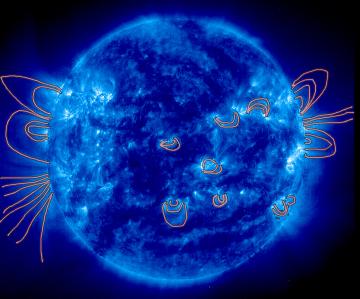
Part of the Sun’s magnetic field. The lines are “magnetic field lines”: a way of visualizing a magnetic field. Credit: NASA/SOHO 2002
Why don’t we get “Earthspots”?
The Earth isn’t made of plasma. This makes our magnetic field less prone to tangling, and if a loop of our magnetic field DID poke through our surface we’re not hot enough or made of the right stuff for it to affect the temperature. (I’m pretty sure – maybe we should check with a solar physicist on this one).
Where’d I Get My Info?
Berkeley – Good info, well written. More advanced than what I wrote.
~ A l i c e !
May-June Sky
Pretty Printout
Notable Sky Objects
SATURN
Saturn is still tilted edge-on to us, making fun telescope viewing. Look for it just below Leo’s tail. Note of interest regarding Saturn observation: Carolyn Porco, Cassini Imaging Team Leader, was the science consultant for the new Star Trek film – so when you see it keep your eyes peeled for the obvious contributions of an intelligent science consultant. If you want to watch for it, her name is 2/3 of the way through the credits, just AFTER the Klingon/Romulan language consultant.
JUPITER
We’ve got both gas giants this month! Jupiter will be rising late around 2am at the beginning of May and slowly creeping earlier till it rises about 10pm at the end of June. It should be shining bright for your viewing enjoyment.
EVENTS
June 6 – Moon will hide Antares, if you’re watching from the United States.
June 20 – Summer Solstice!
New Constellations
SCORPIUS – The Scorpion
SCIENCE: Scorpius is in the same direction as the Milky Way – so if you imagine the shape of the constellation as a teapot, the very middle of our galaxy would be the tea pouring out of that teapot. That’s where the supermassive black hole at the center of the Milky Way is – but you’ll never see it, no matter how hard you look.
Antares (alpha scorpii) red supergiant of variable brightness with a close blue-white companion orbiting every 900 years. Means “Rival of Mars” (anti-Ares) or “Like Mars”
MYTH: To the Chinese it was a dragon; in the South Pacific, it was Maui’s fishhook used to pull up islands from the ocean floor.
The Summer Triangle (mostly):
Cygnus(the Swan) and Lyra (the Lyre/Harp) reappear, and the bright star from Aquila (Altair). The summer triangle (as you can tell by the name) will be directly overhead come summer, but now it’s low in the East, a harbinger of brighter days to come.
CYGNUS – The Swan
SCIENCE: Albireo – Cygnus’ head is the prettiest double star in the sky. Look through a telescope and it separates into a glowing gold star, and a tiny blue point. This is a good thing to suggest for people with telescopes at home.
MYTH: Do you like gory details? When his brother Phaethon was killed by Zeus and scattered all over the Earth, Cygnus picked up all the pieces. The gods laughed, calling him a “bobbing duck,” picking up all those pieces. Then they started to realize that maybe he was doing a good deed, so they put him in the sky as a “noble” bobbing duck – a swan.
LYRA – The Lyre
SCIENCE: M57, the Ring Nebula is between the bottom two stars in the constellation. It’s pretty hard to pick out, even with a small telescope, but it is a good target for larger scopes, and Hubble has a beautiful image of it.
DELPHINUS – The Dolphin
This tiny constellation is as cute as a bug’s ear … or a dolphin’s. Probably one of the easiest constellations to spot – Delphinus is isolated in a dark part of the sky near Aquila.
MYTH: The four stars that make Delphinus’ head are also called “Job’s Coffin.” You don’t often think of Christianity as the underdog, but in our sky it is: the sky is dominated by the Greek names and stories.
“Tiny” Guys
Going for the Gold? Here’re this month’s itty-bittys.
LYRA – The Lyre
CORVUS – The Crow
CRATER – The Cup
COMA BERENICES – Berenice’s Hair
LYNX – The Lynx
SEXTANS – The Sextant
HYDRA – The Sea Serpent (Big and dim)
LACERTA – The Lizard
LEO MINOR – The Small Lion (Between the Big Dipper and Leo)
VULPECULA – The Fox
SAGGITA – The Arrow
SCUTUM – The Shield
LIBRA – The Scales
CAMELOPARDALIS– The Giraffe
Returning Constellations
BOÖTES – The Herdsman
HERCULES – Hercules
CORONA BOREALIS – The Northern Crown
VIRGO – The Virgin (or “Princess”)
LEO – The Lion
CANCER – The Crab
GEMINI – The Twins
CEPHEUS – King Cepheus
DRACO – The Dragon
URSA MAJOR – The Great Bear
URSA MINOR – The Little Bear
CASSIOPEIA – The Queen
Where’d I Get My Info?
My memory, and Zeta Strickland
~ A l i c e !
Smithsonian Photography Contest
Pretty Printout
click! Photography Changes Everything is an online exhibit put on by the Smithsonian, and they’re looking to celebrate the International Year of Astronomy with us!
If you like photography and you like writing you might like to submit a photo and a short story.
This month’s focus: Seeing Other Worlds
Submit a photo showing how photography influences our ability to see ‘unseen’ or unfamiliar worlds to become part of this month’s focus, Seeing Other Worlds.
Some things to consider: How can photography help us see things that would otherwise go unnoticed in our everyday lives? How does micro- and macro- photography (e.g. from microscopic bacteria to galaxies far beyond the earth) change our perception of the world and our place in it? How do new imaging technologies and software (e.g. MRI’s, CAT scans, Google Earth, etc.) change what we’re able or want to see? How does photography shape awareness and shape our perception of other communities, cultures and lifestyles?
I can’t find a deadline, and I’ll bet that’s because the exhibit goes on all year, but with different themes at different times.
It’s an interesting exhibit – take a look around.
~ A l i c e !
P.S. I promise to have an astronomy post for you soon – I’m working on putting together an overview of the new sky.
Carnival of Space #100
Pretty Printout
Wow – this carnival is one not to miss. Hosted by the One Minute Astronomer, this week’s Carnival of Space is a wonderful collection of awesome astronomy news and explanations.
~ A l i c e !
Earth Revealed: Astronomy Day 2009 at Pacific Science Center
Pretty Printout
Come one, come all to Pacific Science Center’s celebration of Astronomy on May 2, 2009 from 10am-6pm.
Here’s the quote from our website:
Earth Revealed
This spring, Pacific Science Center celebrates local scientific research focusing on all of the amazing things scientists learn by looking at Earth from satellites circling our planet in space. This series of programs showcases local scientists, allowing our visitors to meet and participate in hands-on activities with the people who conduct this cutting edge research.
[Our] month long celebration [Earth Revealed] culminates with a Special Event, Saturday, May 2, 10:00 a.m. – 6:00 p.m. Join Pacific Science Center as we showcase Earth as you have never seen it before. Over twenty hands-on activity stations will be ready to explore, all facilitated by local scientists. Additionally, KING 5 meteorologist, Jeff Renner will make a special presentation! This event is targeted to families with elementary and middle school aged children although will be most appropriate for kids 8-years-old and up.
Awesome Science!
Our ability to look back at Earth from space, using satellites and other space craft, has transformed what we know about our home planet over the last fifty years. From space, we can see weather patterns such as hurricanes and features such as glaciers, volcanoes and oceans in a whole new way. For the first time in human history, we can see ourselves living on and altering a dynamic planet. Discover this fascinating area of research during Pacific Science Center’s Earth Revealed: A View Of Our Planet From Space events!
Learn how scientists:
- Understand and predict hurricane intensity by combining satellite data with information gathered during flights into real storms!
- Study the beautiful and awe inspiring Northern Lights!
- Determine the make-up of Earth’s atmosphere, and then look for similar planets outside of our own solar system!
- Discover how fires affect our forests!
- Gather information about the location and thickness of sea ice and glaciers!
Partners:
University of Washington participants include Applied Physics Lab, College of Forestry Resources, Department of Astronomy, School of Oceanography, Department of Atmospheric Sciences, Department of Earth and Space Sciences and Department of Electrical Engineering. Other event participants include Microsoft, JISAO, Central Washington University, KING 5 News and NOAA National Weather Service.
In addition we’ll have planetarium shows (first come, first seated, and seating is LIMITED!) every hour on the hour, astronomy crafts and activities scattered throughout the buildings.
I got to meet a couple of these scientists last week at one of the events that have been going on all month. They’re fun to talk to, have cool stuff to show you, and best of all make it easy to understand!
~ A l i c e !
Logo
Pretty Printout
For those of you who wanted to use my logo to link to me – I dropped a slightly more manageable version at the bottom of the left-hand column. It should also show up as a choice when sharing links to my site through facebook and the like.
Now don’t go abusing this and making it look like I support things I don’t!
~ A l i c e !
Carnival of Space #99
Pretty Printout
Welcome, one and all, to the 99th edition of the Carnival of Space. I feel special to host the last two-digit Carnival (and I can’t wait to see who gets #100!).
On with it!
I present this week’s Carnival in the form of my best recipe for bread (my friends call it Alice Bread, and it is quite easy to make):
- First you need 1 Cup hot water (as hot as you can get from the tap) – and in that vein Christopher of the fairly new and piping hot Innumerable Worlds presents an analysis of the Sun’s wobble (What if we were looking back at ourselves from 10pc away? Would we detect the worlds we have here?).
- Next, Brian, Next Big Future, tells us about eensy-weensy solar sails that are probably smaller than the 1 Tbsp Regular Yeast you’ll need next, and space based solar power.
- Make sure your yeast is at least as fresh as the radio news from Nicole at One Astronomer’s Noise – don’t try this with a packet that’s been in the back of your cupboard for years.
- A Babe in the Universe, Louise, celebrates Yuri’s Night with at least 1 Tbsp Sugar.
- You can use any sweetener you like – just something for the yeast to eat, and to add a little flavor to the bread, and Alan from MSNBC offers a number of choices, addressing the questions of space-based solar power, Hubble’s “Hand” in space, and rocket racers.
- Mang from the 433rd faces the oil (1 Tbsp Oil, that is) and water of the Pluto question.
- Kimberly from the Chandra team shows us what Chandra is up to, combining its data with that from other scopes, just like I use various oils to get various flavors in this bread: I use olive for a “French” bread, and canola for a slightly plainer taste.
- Emily, Planetary Society Weblog, loves the shadows on Saturn’s Rings, rings which we all know are made of tiny particles – just like the 3-5 Cups of Flour you’ll require.
- I use All-Purpose white flour from the USA – if you love whole wheat I’d do several experiments instead of using this recipe as is. Speaking of experiments, Brian, the One-Minute Astronomer visited base camp for some very famous ones, and reports on his visit to Palomar. (Also, if you live in another country your flour may have a different gluten content, so try this recipe and let me know how it works, but the recipe is very flexible, so I’d expect it to turn out okay).
- Heat a bowl. Ian from AstroEngine examines the Sun’s theoretical binary companion: it wouldn’t be very hot, comparatively, but still significantly hotter than you need to get the bowl you’ll be working with. I heat my bowl by running the backside of the bowl under hot water until it doesn’t feel cool anymore.
- Put your hot water in the heated bowl, which is where the Mars Sample Return missions David at Rocket Explorers looks at never quite got.
- Mix sugar and oil in with the hot water (the goal is to have warm, happy, well-fed yeast). I mean, if you were going to go meet aliens around another star, wouldn’t you want them to be warm, happy, and well fed? Paul from Centauri Dreams talks about human interstellar flight versus robotic probes creating a “telepresence.”
- Add yeast to your hot water mix. Paul of the Meridiani Journal examines strange formations on Mars, much like the strange formations you’re about to observe in your yeast.
- Stir once, and while you do so read Stuart’s presentation “Rover Hugger” (which I can’t wait to finish reading myself!).
- Wait until the yeast reproduces (you’ll see it “bloom” or get foamy). This is the best part! This should take 2-5 minutes, and you can watch it happen before your very eyes. Ethan at Starts with a Bang has also been watching for evidence of “babies” on a much different scale and has the secret to why nature decorates her galactic nurseries for girls.
- Add one cup of flour. Stir, just like Colbert stirred up the ISS-module-naming community over the last few weeks. Robert of Collect Space weighs in on the NASA/Colbert naming resolution.
- Add another cup of flour. Stir, and since he stirred up the community so well, Irene from the Discovery Channel knows just what NASA should do about Colbert.
- Add a third cup of flour, knead in – don’t cut like you would a pastry, or like Occam’s razor might if you were Tycho Brahe: Ian of Astroblog wonders what the real role of parallax measurements in Tycho’s rejection of the Copernican system was.
- Hubble just keeps finding more cool stuff, in this case presented by Phil, the Bad Astronomer, and just like that, if you need more flour, keep adding and kneading – you want to have dough that forms a ball and stays that shape.
- Don’t worry about overkneading, but also don’t add more flour than you need just because the recipe calls for 3-5 cups. Speaking of adding more than one might need (or perhaps not enough), Shubber of the Space Cynics opines about the bailout’s effect on space projects.
- If it’s stiff after just 2.5 cups, let it be – you’re done, but Nancy from the Universe Today hopes this isn’t the case for our space station and that we extend the life of ISS.
- Oil a second bowl. Use the same oil you used in the bread, and speaking of using something you’ve used before, Bruce examines the remake of The Day the Earth Stood Still over at 21st Century Waves.
- Place the dough in the bowl, turn once to get it coated in oil – it might even look like the Moon Alexander of Potentia Tenebras Repellendi is writing about in his search for the Moon’s mother.
- Darnell of Colony Worlds wonders if space elevators are rising in the right direction. Your bread certainly should be: let it rise until it’s doubled in size, covered and warm (About 45 minutes). I preheat my oven to about ~100F (I know, you can’t do that, I just turn it on for 10 minutes and then turn it off and keep it closed).
- Punch down, knead once or twice, and form into the shape you want – perhaps the shape of Ryan’s Moon rocks. He took a short detour from the Martian Chronicles to check out Moon rock processing at Johnson Space Center. I make an oval on my baking sheet, but it works in a loaf pan too.
- Let rise again for at least 15 more minutes, but you can let it go for up to 45. At least you don’t have to wait 520 days like the people on the mission to Mars currently happening in Moscow. Bruce from Music of the Spheres reports.
- Bake in a greased or completely non-stick pan at 350° F for 45 minutes. Speaking of baking, I really don’t want to be on this mission: Ralph from Discovery Enterprise suggests we send crewed missions to Venus, and Alex found a video about a Mars mission based on Apollo technology.
Okay, so my grammar had to get a little weird there, sorry. It’s kind of hard to make a carnival list fit a recipe.
Please comment to let me know about any mistakes. If you’re not out of time yet, don’t miss the past couple Carnivals:
Have fun!
~ A l i c e !
GPS Satellites
Pretty Printout
Now that we’ve got this fun exhibit “GPS Adventures” here at Pacific Science Center I’m getting some questions about the GPS satellites themselves.
How many GPS Satellites are there?
This is a more fascinating question that you might think. Everywhere I look the answer is “more than 24.” I find that confusing. Do you mean 25? 30? Can’t you count them? Well, actually, not so much.
The way the technology is set up means that there need to be at least 24 operational GPS satellites at any given time. So, when one breaks there needs to be another already up there to take its place. I counted 25 on NASA/JPL’s JTrack list today. There have been as many as 30 in the past, and they’ll launch more as those 25 get older and need to be replaced.
What kind of orbit are those satellites in?
A group of satellites is called a constellation. The GPS Satellites all orbit about 11,000 miles above the earth’s surface in a Middle Earth Orbit (MEO) which is between a Low Earth Orbit – like the Shuttle – and a Geosynchronous Orbit – like the satellites that broadcast satellite TV. Satellites in MEO orbit the Earth about twice a day.
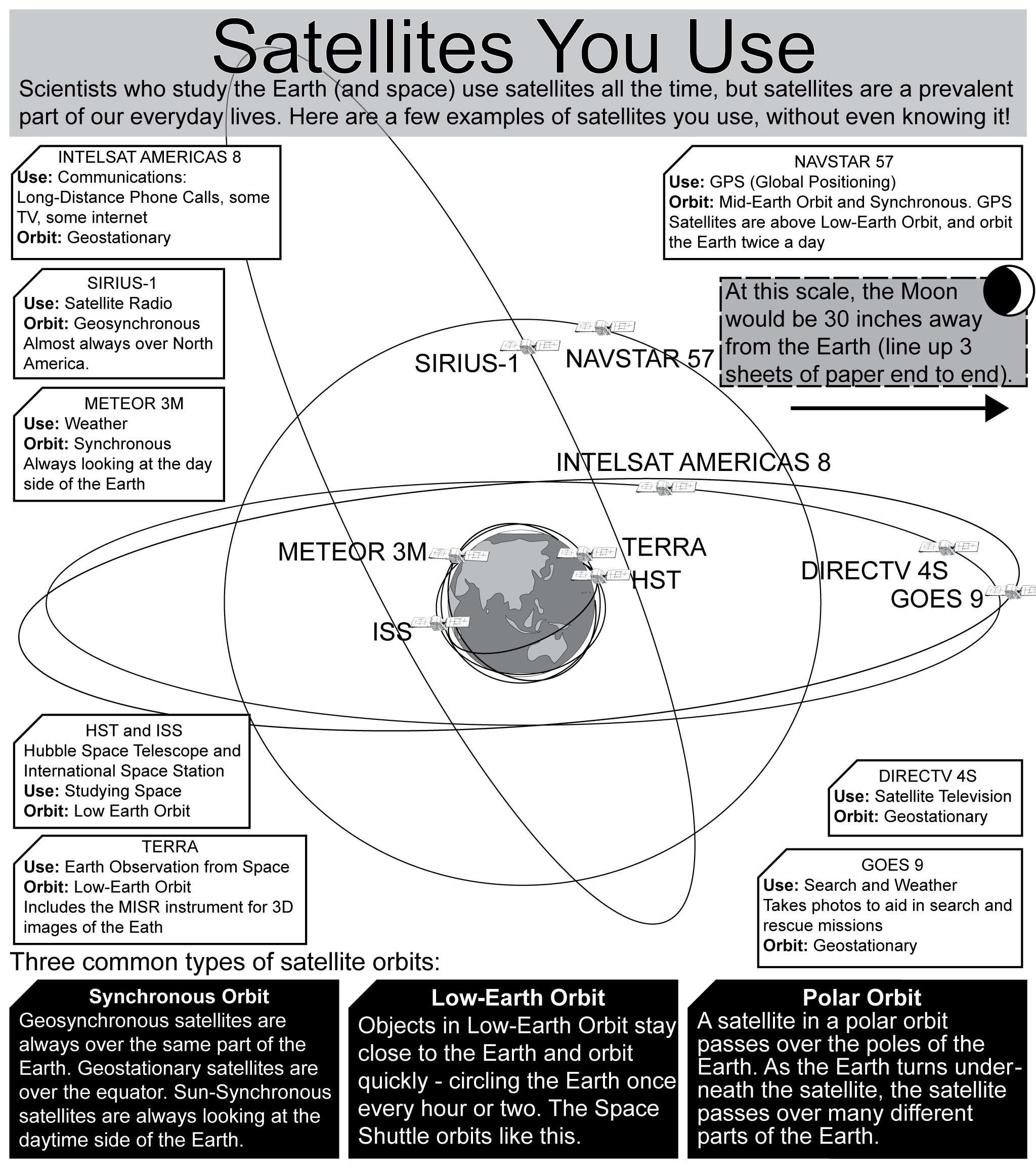
Satellites You Use (a small selection)
How many satellites can you “see” at once?
Always a minimum of five. You only need three for basic positioning, four for better positioning, and five just means if one signal drops for you there’s another waiting.
What is the resolution of GPS?
General GPS (that which you might already have in your car) will pinpoint your location to within a meter or so. Advanced GPS will pinpoint your receiver to within a centimeter! Those advanced GPS technologies are also called “Differential GPS,” “Carrier Wave GPS,” or “Augmented GPS.”
Want More?
Come to GPS Adventures – If you’re interested in GPS Satellites and GPS technology check out the first and fourth rooms of the maze – they’re chock full of information! (Don’t want to get stuck in the maze with a gaggle of kids? Come to our next Science with a Twist – and experience the exhibit with a 21-and-up crowd.)
Check out the back of this month’s starmap – all about satellites you use.
Where’d I Get My Info?
Trimble’s GPS Tutorial
Some of these answers I got from the exhibit itself.
JTrack
~ A l i c e !