Scientists Who Work in Astronomy-Related Fields Needed
 Pretty Printout
It is currently the International Year of Astronomy and Pacific Science Center is embarking on a project with our high school interns this summer to create posters of current astronomers for display at Pacific Science Center and distribution to science teachers this fall. The detailed project description is below.
We have the interns, the cameras, the plan and now all we need is some astronomers! This is where I need your help.
Do you know any scientists who work in astronomy-related fields? Any astronomers? Astrophysicists? Aerospace engineers? Grad students in planetary geology? All of these “count” as scientists for this project – any field that’s even remotely related to astronomy is great for us and any “level” of scientist, from grad student, to post-doc, to professor, to a person who applies these sciences in industry. We would prefer if these people are in the greater Seattle area, or are at least visiting Seattle sometime this summer. We are especially looking for minorities (of all kinds) in the field of astronomy.
We’re hoping to put together about 25 posters that include a photograph taken by the interns and some short biographical information about each scientist: current projects, hobbies, etc. We would love to meet more than 25 scientists so we have lots of choices for the posters.
The photography sessions and interviews will take place during the summer (end of June through early August 2009), and should only take about an hour.
If you know of anyone who would be willing to participate or help in other ways, please send me their contact information or forward this message on to them.
Project Description
Modern Scientists: Everyone Knows What a Scientist Looks Like
Children are inspired to follow career paths when they can imagine themselves there. Seeing pictures of adult individuals who look like them working in a given career can provide this spark to children’s imaginations. As a teaher it is difficult to decorate a classroom with posters of scientists who look like today’s students. Most (though not all) of the current available posters of scientists are of Einstein, and scientists who look like Einstein. This is not representative of the current face of science.
To help change this, Pacific Science Center will host a photography exhibit: photographs of real, current scientists from all races, genders, beliefs, and walks of life. Photos will be taken and short biographies written by interns from Pacific Science Center’s youth development program.
We plan to make the photographs from this exhibit available to teachers for use in their classrooms, in addition to being displayed at Pacific Science Center during the International Year of Astronomy.
The objectives of this project are to fill a need for representative photographs of scientists in the world community and to meet two of the goals of International Year of Astronomy: to provide a modern image of science and scientists, and to improve the gender-balanced representation of scientists at all levels and promote greater involvement by underrepresented minorities in scientific and engineering careers.
Thank you,

~ A l i c e !
alicesastroinfo (a) gmail.com
Life’s boring without Discovery!
P.S. Don’t miss this week’s Carnival – over at cheapastro – and I’m in it for the Mars April Fools post!
Vacations to Mars and Pacific Science Center
Pretty Printout
I’ll bet most of you reading this post are dropping by because you want to visit Mars. (What? You don’t know that Expedia is selling vacation packages to Mars? Well, you really should go book your seat RIGHT NOW before they sell out.)
The funniest thing happened to me earlier this month, I got an e-mail from my friend Corinne Cooley with five extremely detailed questions about Mars. I did my best to help her out, and it turns out she was one of the masterminds behind arranging those vacation packages, and got me that nice link at the bottom of Expedia’s Flights to Mars page.
I’ve had to keep my answers under wraps until today (you wouldn’t want all the seats to be sold before they’ve even announced they’re selling them, would you?) but finally, here they are.
Question(s) One: Would star-gazing on Mars be as good as I think it would? The atmosphere is a lot thinner. On the other hand I know it can be very dusty. What are your thoughts for on average, and in best conditions? If dust can’t be up to have good gazing, are there any regions on Mars that are significantly less prone to dust storms, or significantly less impacted in a ‘visibility through atmosphere’ sense?
Impacts on Stargazing:
- Light Pollution – you’ll have none of this, and this takes our viewing from the ability to see ~4000 stars on Earth to seeing ~100 in a city.
- Moon Glow – another form of light pollution, but with tiny moons, you’re not going to have a problem here at all. You also will never see a beautiful crescent moon set just after the Sun, or a solar eclipse.
- Atmosphere – This affects seeing more than it affects ability to see. Whoa – confusing? Atmosphere will make things wobbly, and more atmosphere will blot out some dim stuff you can see. Although the astronauts have the best view ever, they could also only probably see about ~4000 – ~6000 stars if they were looking away from the Sun and their eyes adjusted. We can see that lower number from a great location on Earth.
- Water Vapor (clouds etc) – We have a lot of this on Earth. There is some on Mars too – we saw snow falling from clouds towards the Phoenix Lander, and we have time and again seen clouds on Mars. You’ll have SIGNIFICANTLY less, so I would not expect your stars to twinkle nearly as much as they do here.
- Particulate Matter (dust storms) – So, Mars has periodic global dust storms. Looks like ten in the 30+ years that we’ve been watching. At this time you’ll see nothing, and you’ll hunker down under a rock and wait for it to pass.
Quote from Dr. Tony Phillips: “Because the martian atmosphere is thin–about 1% as dense as Earth’s at sea level–only the smallest dust grains hang in the air. “Airborne dust on Mars is about as fine as cigarette smoke,” says Bell. These fine grains reflect 20% to 25% of the sunlight that hits them; that’s why the clouds look bright. (For comparison, the reflectivity of typical martian terrain is 10% to 15%.)”
- Even looking through smoke is no good for stargazing, so I’d avoid the dust storms altogether. I’ve heard of two big dust storms coming out of Hellas Basin – and I’d avoid all the plains. More research is necessary, but that’s my first shot.
P.S. You’ll have a different North Star, but all the constellations will be the same

Stargazing from Mars - those are the two moons going by. (from NASA)
Question(s) Two: I’m interested in the concept of Martian tourism. Imagine a lightly developed Mars – you can get up there, there are multiple places you can go to and there’s support for people to stay there, but it’s not all the way ‘tamed’ by any means. What would be the coolest things to do? Of course you have less gravity, extra minutes in the day, and the biggest mountain and canyon in the solar system. Anything jump to mind beyond the obvious?
- Walking up the smooth side of Olympus Mons would be like a stroll in the park – as long as you can keep up the stroll for 375 miles. The grade isn’t even a hike – it’s ADA compliant (you could go up it, easily, in a wheelchair). Now the other side – the scarp – is an ~11km tall vertical cliff. Different story.
- I’d check out the landing sites for the Vikings, Pathfinder, Rovers, and Phoenix. I’d also go on an expedition to see the Beagle crash site.
- Watch out when you’re at the side of Valles Marineris – I’ve heard the winds sweeping over the sides and into the trench could knock you over. I tried to double check that, and came up with nothing though…
- I’d be interested in exploring those fjord/trenches up by the North Pole – they look … interesting.
- Credit: “Fjords” at the North Pole http://www.windows.ucar.edu/tour/link=/mars/places/mars_poles_image_gallery.html
- “Search for Water” – if we had people there, they could go to those crater walls where we’ve been seeing seepage and figure out for sure what it is. I’ll bet this would be as attractive as dowsing.
- “Chase the Dust Devils” – we don’t understand these even on Earth, and there are tons on Mars.
- The Face on Mars – it’s just a field of rubble, you won’t see anything there, but you could go anyway. (Expedia included this, it’s Activity #6 – Pareidolia Tour!)
- No matter what you’re going to need a warm polar jacket. Like the ones they take to Antarctica.
Question(s) Three: Mars humor. Are there any really great/terrible Mars specific jokes that you are aware of? Or even farther out, general astronomy humor? I’m looking for humor that would be mildly accessible to a layperson but thrilling to a geek.
I don’t have ANYTHING really. My favorite is that HP ad that was on TV where the Martians are printing out the Panorama just as fast as Pathfinder can take the pictures.
- How can you tell Mars isn’t married?
- It doesn’t have a ring.
Classic, can be used for the Moon too:
Person1: Hey, I went to Mars the other day
Person2: Wow! Cool! How was it?
Person1: Meh, there wasn’t much atmosphere ….
Question(s) Four: Any super super cool recent Mars happenings? Any really interesting current mysteries that would be fun to speculate on? (I heard there’s methane emissions going on up there, indicating either geologic or biologic activity…)
- Yeah, that methane is almost certainly geologic. The cool part about it is that it is renewing itself. That means there is a source where something is happening.
- Mars Odyssey successfully rebooted!
- Spirit and Opportunity both had errors recently – but they’re back up and running. This is not unexpected, they’ve lasted 5 years when they were supposed to last 90 days! (I love it when the rover’s solar panels are cleaned by wind)
- We got a beautiful picture of Deimos.
- Lobate flows can be kinda a big deal.
- We found water on Mars!!! (Over and over and over and over again)
Question(s) Five: I’ve seen Yahoo is doing a Mars weather forecast. I need to do more digging myself but do you know anything about where this kind of data might be publicly accessible? (RSS feed would be the BEST.)
- Looks to me like Yahoo’s forecast is static, but here’s one that’s not! (Here’s where I found that.)
- This is where data is stored about Mars. It takes some effort to get around in, and sometimes it isn’t up to the minute, but this is the archive. As up-to-the-minute as it gets is the raw data from the Mars Rovers and Hirise.
~ A l i c e !
Where’d I Get My Info?
Stargazing and Dust on Mars
This was the original intro to this post. It doesn’t make sense now that Expedia’s not pushing their April Fools site as heavily. (Changed 4/2/2009)
Hello! Welcome newcomers, to Alice’s AstroInfo!
If you’ve gotten this far you probably want to know more about me. The best way would be to click over and visit my place of employment:
Pacific Science Center
It’s an awesome interactive science museum in Seattle, Washington (USA) and if you visit their website, you could help show them that my little blog and I are a force to be reckoned with!
Carnival of Space #96
Pretty Printout
AstroEngine is hosting this week’s Carnival of Space (and my post about Susan Sakimoto is there, alongside Phil’s discussion of the merits of the Kepler mission).
What are you waiting for? Go check it out!
~ A l i c e !
American Moon Illusion
Pretty Printout
Dear Alice
Recently a friend of mine told me that her friends from India insist that the moon in Seattle is bigger than the moon they see back home. Could this be true?
I’ve often wondered why the moon appears larger near the horizon and why I can’t capture that huge moon in a photograph but it has never occurred to me that the moon might appear larger or smaller from different places on the planet. What’s with that?
Thank you for any insight you might have.-Terry
Terry,
In short, the Moon is always pretty much the same size, no matter where you’re looking from, and no matter where it is in the sky. All those differences are an illusion. I’ve been poking around though, and I can’t find anything about the “American Moon” vs “Indian Moon” illusion. I’ve got a number of resources on the Moon Illusion in general (why the Moon looks so big near the horizon) but only guesses about why it would happen more here than in India.
Moon Illusion
There are many books and papers written on the subject, but in short, no single theory really explains the Moon illusion. The popular explanations are these:
- There are reference points for our brains near the horizon, but there are not reference points straight up. Hence we do a better job of judging the distance and size of the Moon when it is low – near mountains and trees.
- Our brains flatten the sky. If you ask someone to judge how high something is in the sky they will always overestimate. This is why people often think the Sun is directly overhead, and if you’re up here near the same latitude as Seattle, the highest it will get is about 66 degrees. Therefore we think things above us are closer, and therefore they must be smaller. (I’ll bet this is related to our estimation of slopes – you know how you were telling your friend about that mountain you skied down that was at a 45 degree angle? Well, it wasn’t, it was much less of a slope than that.)
- Relative size: this seems similar to #1, but it’s a little different. Because there is stuff next to the Moon when it is near the horizon it looks larger. When the Moon is high there is no stuff next to the Moon and we assume it is small.
- There are also some ideas about how the eye perceives things.
None of these theories actually accounts for the illusion. The only for sure part is that the illusion is definitely all in your head – if you measure or photograph the Moon when it looks big and when it looks small you’ll see that the two measurements and pictures are pretty much identical.
Also, I’ve heard it told that if you see one of these large Moons, and you turn your head so you’re looking at it upside down, the illusion disappears. (Actually, what I heard is if you turn around, bend over, and look back through your legs the Moon will look normal, no illusion, because you’re looking upside down).
Indian Moon vs American Moon
I am absolutely positive that your friends are telling you exactly what they see. I also checked in with a couple of my husband’s coworkers who are originally from India, and visit home regularly. They agree that the Moon seems larger here, though they’ve never heard it talked about.
Here are my two thoughts:
Pollution
I don’t have good numbers to back this up, but of the over a billion people in India, tens of millions live in the big cities. Also, and here I’m really speculating, I would believe that of the people who visit or move to the US, a high percentage are from the cities.
The cities in India are notorious for their air pollution. That’s no good for looking at the sky. Also, if you’ve ever seen the Sun during a dust storm, or, more likely here in Seattle, through a haze of clouds (NEVER LOOK DIRECTLY AT THE SUN) you know you can see the disk of the Sun, and it looks smaller than you expected. The particles, be they dust, smoke, or water droplets, in the sky dim it down and take away the glamor of the Sun. It’s not as glowy, so it looks smaller.
How High the Moon
The latitude of India is between 5 degrees North and 30 degrees North. The latitude of the US is between 25 degrees North and 50 degrees north (yes, I’m ignoring Alaska, because that would just strengthen the argument). I give you those numbers to support for the idea that in India the Moon spends more time higher above the horizon than it does in the US. This would mean that we get the regular Moon Illusion for more of the Moon’s path through the sky (not just at Moonrise and Moonset) here in the US than you would in India. (Obviously the Moon can always be much lower, because it has to rise from the horizon, which is why I’m only looking at the highest part of the Moon’s path)
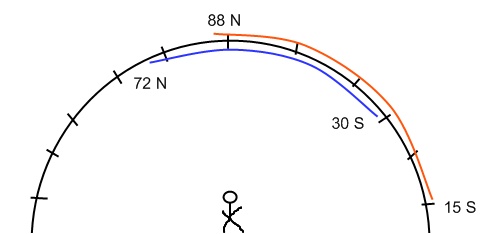
The red is the highest possible altitudes for the Sun in the US, the blue is the highest possible altitude for the Sun in India.
Here are some numbers to support that argument. If you don’t like numbers, skip this paragraph. Those latitudes means the highest the Moon gets in the US (in Florida) is two degrees past the zenith, and the lowest high (in Washington State) is about 15 degrees above the horizon. In India the lowest the Moon can get (when it is at it’s highest point in its path across the sky) is 30 degrees above the South horizon, and the highest it can be is all the way over to 72 degrees above the North horizon.
P.S. Moonwatch Week
Hey! I just noticed that it is Moonwatch week over in the UK. Heck, it’s the same Moon, so it might as well be Moonwatch week over here. So – this post is belatedly in honor of Moonwatching. Go out and look!

~ A l i c e !
Where’d I Get My Info
Griffith Observer I read a good article in a recent issue, but I can’t find the details right now.
Ada Lovelace Day and Carnivals of Space
Pretty Printout
Susan Sakimoto
I want to tell you about Susan Sakimoto. No, you haven’t heard of her. No, you won’t be asked to write a report on her (at least, probably not this year). She was the unofficial adviser for my Bachelor’s Honors thesis project in Astronomy-Geology at Whitman College. At the time she was working at NASA Goddard, now she’s a professor at Notre Dame. She studies lava flows … on Mars. And the part that really impresses me: she has kids (whose dad also works full-time at Notre Dame), she runs, and yet somehow her house is still cleaner than mine. Let me reiterate that:
Susan has:
- children (and it’s not like they have a stay-at-home-dad instead of a stay-at-home-mom)
- a full-time job – doing science (which you kinda never stop thinking about, and sometimes you have to work all night on to meet deadlines, and often sends you to meetings in who-knows-where)
- a regular “physical” hobby (not the kind of hobby you can put aside for a month and come back to)
- and then she took me on as an unofficial advisee…
- oh yeah, and her house is clean!
I dunno about you, but one or two of those sound like plenty to me. She’s one of those amazing people who does it all. I often feel like I can barely handle my full-time job and house chores. You start talking to me about kids and trying to make it to yoga every week, regularly, and I start wondering what I can drop or cut short.
I’m impressed, but these women are not rare. I’ve met many of them, and I continue to meet more. The key seems to be commitment. If you set your mind do something, and commit to it, you can. So go for it!
Ada Lovelace Day
So why am I telling you about Susan Sakimoto? Because today is Ada Lovelace day. Ada is widely attributed as the woman who wrote the first computer program. She worked closely with Charles Babbage on developing the first mechanical computers. She is one of the many amazing women in science and technology.
As part of the celebration of Ada Lovelace Day I signed a pledge saying I would write about a woman I admire, someone who works in technology. Unfortunately for me, there are so many women in science and technology I admire, that I didn’t know who to write about! There’s Ada herself, of course, and Annie Jump Cannon, Cecelia Payne-Gaposhkin, and Williamina Fleming. And then there are the current scientists (most of whom you’ve never heard of because you tend not to get famous until you’re dead or almost dead): Hannah Jang-Condell, Susan Sakimoto, Andrea Dobson, Pamela Gay (the list goes on and on and on). As you now know, I finally settled on Susan.
Carnival of Space
In the interest of clearing up loose ends – I owe you links to several Carnivals of Space:
- Carnival of Space #94 – Including the announcement that Bad Astronomer is giving away a Galileoscope!
- Carnival of Space #93 – Including a discussion about whether you’ll be able to visit ISS as a space tourist.
- Carnival of Space #92 – With bits about the crash of the Carbon Observatory …
Where’d I Get My Info:
http://www.sdsc.edu/ScienceWomen/cannon.html
http://www.carleton.edu/departments/PHAS/Astro/pages/marga_michele/Cecilia_Payne.html
NASA Update
Pretty Printout
Question: As you probably know, several of us from Pacific Science Center, went to a NASA Forum at the Museum of Flight on January 25, 2008. NASA officials talked about a very complicated plan for a manned-Mars mission sometime this century, using a permanent Moon base as a starting point. Have you heard anything more about this possible reality?
The Constellation Program
The program you’re asking about is called “Constellation” and the first goal is to put people back on the Moon by 2020. Indeed, the program is up and running and NASA is making progress as each day passes. The Constellation Program has three basic components. Let me look into the status of each.
The Orion Crew Vehicle:
Status: design and component mock-up
Currently NASA has a mock-up of the Launch Abort System being driven across the country to the White Sands test range. (Trust me, you want the launch abort system to work.). Actually, by the time you read this the LAS has probably already arrive at the facility for testing. NASA hopes to have finished testing and begin building by 2012.
The Ares Launch Vehicle:
Status: components built, in preliminary testing
As you can see from the picture here, the Ares 1 rocket fires just fine. Now the question becomes – is that firing under control? Is it exactly the thrust needed? Do the scientists and engineers have the control over it that they expected to have? NASA hopes to have finished testing and begin building by 2012.
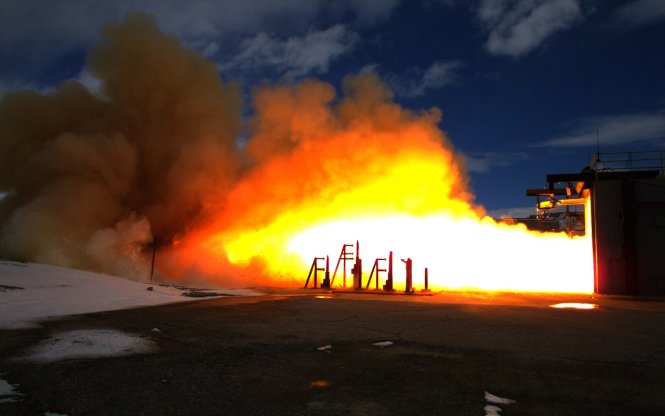
Ares Rocket Testing Credit: NASA
The Altair Lunar Lander:
Status: design, rocket testing.
The Lunar Lander itself is mostly still on the drawing board, but NASA staff are testing out various rockets and modeling various designs.
Alice Enevoldsen
Where’d I Get My Info?
Earth Hour
Pretty Printout
My website is going to go went black for Earth Hour – http://www.earthhour.org/home/
Join me!
New Home! Welcome!
Pretty Printout
Hi! Welcome to my new home … but bear with me, I’m still moving in.
P.S. If you’re new, and don’t know who I am or why I’m here, I run the Pacific Science Center’s planetarium in Seattle, WA. Come and visit, we’re the only planetarium in Washington that has regular public shows – and we’ve got shows EVERY DAY!
Planets Cards!
Pretty Printout
Do you need a Solar System? I’ve got one for you.
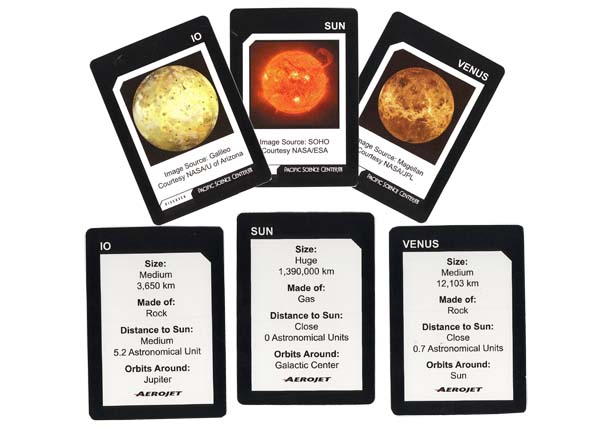
Bear with me, deep linking to the following website doesn’t work, so follow these quick instructions to acquire your own Solar System:
- Go to Pacific Science Center’s website: http://www.pacificsciencecenter.org/
- Click on “Store” in the middle of the right-hand column.
- Click on “Gifts” in the left column.
- Click on “Educational” in the middle pane.
- You’re there! See “Solar System Cards” in that list? I made those. There are 44 awesome objects in our Solar System – plus several blanks and a list of suggested activities.
Funny Story:
So a few years ago, shortly after receiving my teaching certificate, Pluto was “demoted.” (In fact, my very first AstroInfo was about the new definition of planet!) Although people have many, many feelings about this, and there’s an ongoing argument, I’m going to ignore that part of the story for the time being.
What this created was a difficulty for teachers. Do we still teach Pluto? Does “My Very Eager Mother Just Served Us Nine Pizzas” become “My Very Eager Mother Just Served Us Nachos”? Does “Mary’s Violet Eyes Made John Stay Up Nights, Period” become “Mary’s Violet Eyes Made John Stay Up Nights”? What if Pluto is reinstated next year? What if you live in Illinois?
Well, the first question is easy. You most definitely still teach about Pluto. It’s not like the demotion made it evaporate out of our Solar System or disappear into nothingness. In fact, now it is probably more important to teach Pluto, since it’s the best-known representative of several whole classes of objects (Kuiper Belt Objects, Plutinos, Dwarf Planets, and Trans-Neptunian Objects). As we discover more and more of these, kids (and adults) need to know at least where these new discoveries are taking place. Teaching about Pluto helps with that.
But if it’s not a planet, what is it? What do I call it? What if they change the name? How can I teach science, if science is changing all the time? Those first two questions you can look up on the internet. The second two suggest some thought.
How can I teach science, if science is changing all the time?
This is a great question, and it applies to more than just “The Pluto Debate,” but that’s where I started. And it turns out, I wasn’t the only educator working on this problem. Anna Hurst from the Astronomical Society of the Pacific, and John Ericson at the Lawrence Hall of Science were also focusing on giving teachers a new way to teach the Solar System in the wake of The Pluto Kerfuffle. We were not in correspondence. We were not discussing this with each other, we did not meet and work on this problem together. In fact, I don’t think I met either of them until long after this.
Yet we all came up with the same solution: a set of cards or slips of paper, each with information about a different object in our Solar System. Teaching the Solar System was going to have to evolve from “facts about each of the nine planets” to something that was more closely related to a lot of what planetologists actually do: classify, categorize, and identify. This mean that the new way of teaching the Solar System needed to involve dozens of objects, not just eight or nine, because there are actually dozens, hundreds, thousands of objects in our Solar System!
Besides the inherent flexibility and educational merit of this new activity, it also gives you a positive and fun way to teach about what happened to Pluto. You can allow your students to make their own definitions for planet, and see which objects fit (or don’t fit) their definition.
Anyway, I find it fascinating that the three of us came up with the same activity independently. I’m sure that many other teachers around the world also must have thought of this idea too, and so I claim no copyright or patent on the activity, but if you don’t have time to make your own set of 30-50 cards, you can (finally) just purchase a set from us – and support both my job and my planetarium while you’re at it!
If you’re interested in John and Anna’s versions:
Lawrence Hall of Science Gread Explorations in Math and Science (since I can’t remember exactly which module has this activity, I’ll send you to the general link. If you know where it is, let me know!)
Astronomical Society of the Pacific’s The Universe in the Classroom, Issue #70 Hubble Observations of Pluto and Ceres. Scroll all the way down to “Activity 1: Sorting the Solar System” and the cards are there.
There is also a printable (draft) version of my cards, but I recommend ordering a nice set from above, since all the attributions for the photographs are correct, and multiple people have proofread them. The drafts will get you through the activity just fine, but the cards are a bit better.
NASA Mission Madness
Pretty Printout
You know how in sports they have playoffs with brackets where you predict which teams are going to win, and then of the teams that are left you make more predictions and so on until you have your prediction for the winner of everything?
I just spent half an hour on NASA’s “Mission Madness” predicting which Mission will “win” their “playoffs.” It was hilarious, and they made some of the decisions pretty hard.
Which do you think will win in a playoff between Hubble and Apollo 11?