Earthquakes and the Length of a Day
 Pretty Printout
The fabulous and illustrious duo Beth and James requested that I educate you all further on the relationship between the Chilean Quake and the rotation of the Earth. A worthy topic.
In Short
The big earthquake in Chile shifted enough of the mass of the Earth far enough that (like a figure skater bringing her arms in toward his body) the Earth actually sped up slightly – shortening our day by 1.26 microseconds. Maybe – the number will be refined further.
Quote
JPL research scientist Richard Gross computed how Earth’s rotation should have changed as a result of the Feb. 27 quake. Using a complex model, he and fellow scientists came up with a preliminary calculation that the quake should have shortened the length of an Earth day by about 1.26 microseconds (a microsecond is one millionth of a second).
Perhaps more impressive is how much the quake shifted Earth’s axis. Gross calculates the quake should have moved Earth’s figure axis (the axis about which Earth’s mass is balanced) by 2.7 milliarcseconds (about 8 centimeters, or 3 inches). Earth’s figure axis is not the same as its north-south axis; they are offset by about 10 meters (about 33 feet).
-JPL Media
In Detail
Overwhelmed? I’ve highlighted the pieces you should pull out of that.
Conservation of Angular Momentum
You cannot create energy or matter out of nothing. These laws are called “conservation of matter” and “conservation of energy.” We’ve got one for spin (angular momentum) too. If you’re spinning you either keep spinning (at the same speed) or you pass off some of that momentum to another object. This causes the oft-referenced effect of the figure skater’s pirouette. She begins to spin with her arms out, gets up some speed, and then pulls her arms and legs in tight. She spins significantly faster in this configuration. Later she puts her arms out again and slows down.
You can do this at home. Grab two cans of food and a spinning office chair. If you do not also find yourself at least fifteen by fifteen feet square of clear space, I take not responsibility for your bruised knuckles (you WILL knock into something if you don’t have plenty of room around, so don’t hurt yourself). Get a friend to start you spinning, with the cans held at arms length in your hands. As soon as you’re going, pull the cans in to your body. Try it the other way – starting with your arms in too.
This is conservation of angular momentum.
Figure Axis
Why were we talking about that? Because of the figure axis. You know the Earth is round, and you also know the Earth is not a perfect sphere because of that hill you had to bike up to get to work today. The Earth rotates on its axis, once a day, and that axis is pointed at the North star.
Now, imagine your washing machine – it spins too. Where is that axis? Yup, right down the middle. The figure axis is different though – it’s the axis around which the mass is all balanced. In a normal situation for your washing machine, these two axes are about the same. Now imagine it gets off balance – all your clothes end up on one side of the drum.
First, where is the spin axis? Yes! Same exact place – right down the middle (sorta, you hope). The mass (your soggy clothes) have changed places though, and they’re all on one side. Imagine a line that intersects the middle of the clothes pile. It’s off to one side, and in fact, as the washing machine spins, the figure axis is rotating around the spin axis with the clothes.
Re-balance your load of laundry so it doesn’t make your washing machine walk and let’s talk about the Earth.
The Earth’s figure axis (balance of mass) is very close to its spin axis, but they aren’t the same. If you move one of the Earth’s plates a lot – it’s like moving the towel in the laundry around, you’re messing with the balance of the mass. In the case of the Chilean earthquake we have one plate subducting under another, which means some mass moving closer to the center of the Earth. It’s not moving far, it’s not getting that much closer to the Earth, but if you’re doing minute calculations it is definitely enough to have that conservation of angular momentum effect (spin a little faster as mass moves in) due to the shifting of the mass of the Earth.
Calendar Change
A student came up and asked today if that meant the atomic clocks needed to change. Well, no, but the atomic clocks are pretty much just counting time passing anyway, in oscillations specific atoms. The question you want to ask is, are the “atomic calendars” going to change?
First off, I must point out I don’t know if there are calendars kept to the level of accuracy that is implied in the term “atomic calendar.” Perhaps these folks?
Second, no, not yet. Richard Gross’s calculations are preliminary. Once they are solidified, the next leap second will take care of it. Does that mean a leap second isn’t actually exactly a second?
Want More?
Microseconds – a measure of time
Milliarcseconds – a measure of angle (like a degree is a measure of angle)
International Earth Rotation and Reference Systems Service
I’m embarrassed to say, but I got the idea for the washing machine analogy off Yahoo Answers. I was just going to use the figure skater till I read the concept there. I’m also going to have to talk about the ways the Earth moves sometime.

~ A l i c e !
Carnival of Space #147
Pretty Printout
Check out Carnival of Space #147 hosted by Weird Sciences. Phil’s got a great post linked.
~ A l i c e !
Earth-Centered Events
Pretty Printout
Today is “just” some photos for you of the Earth-Centered events that have happened over the last week. First, Earth Hour just finished here in Seattle – so a pretty before-and-after of Pacific Science Center and the Space Needle. (Click to get the full-resolution versions).
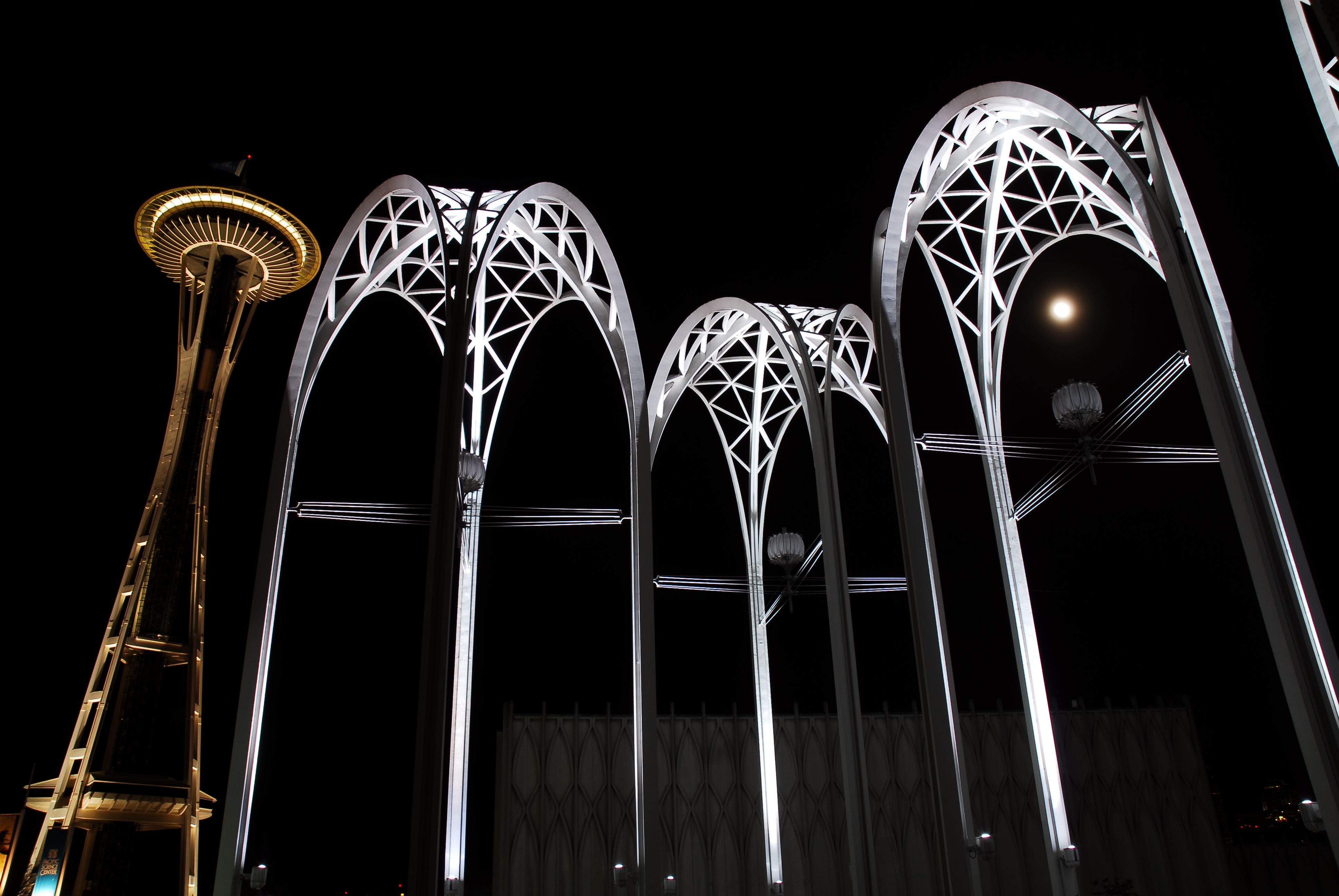
Pacific Science Center before Earth Hour 2010 Photo: (C) Jason Ayres Gift Enevoldsen
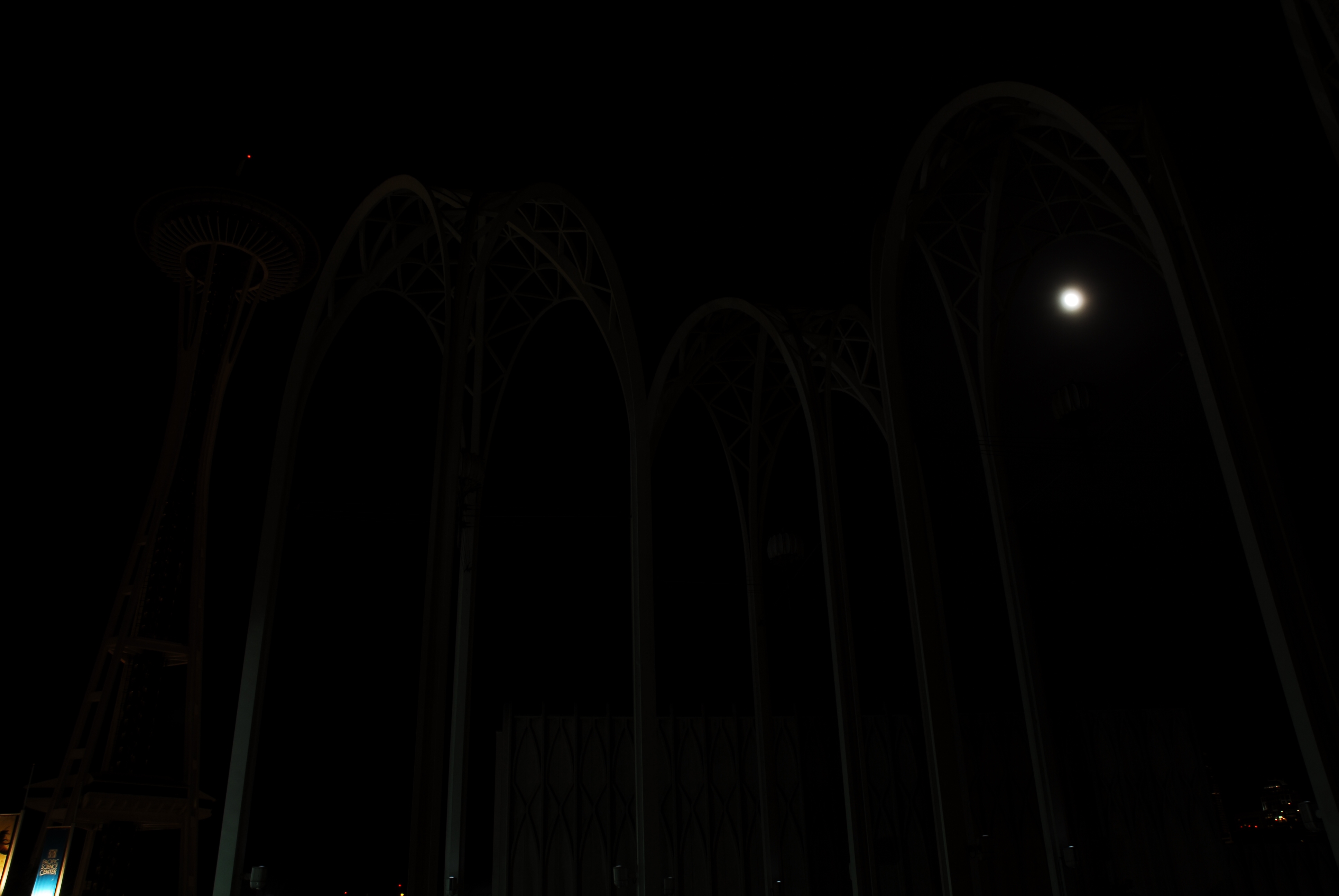
Pacific Science Center during Earth Hour 2010 Photo: (C) Jason Ayres Gift Enevoldsen
Equinox Sunset
I haven’t had a chance to tell you how fun the West Seattle 2010 Spring Equinox Sunset Viewing at Solstice Park was. Unfortunately, we didn’t see the Sun … remember, this is Seattle. If you schedule a sun-dependent event, it will be cloudy. Anyway, we had 30-40 folks show up, and had a good time anyway. Greg posted a nice piece over at the Seattle Astronomy Examiner about it. (Click pictures to see high-res)
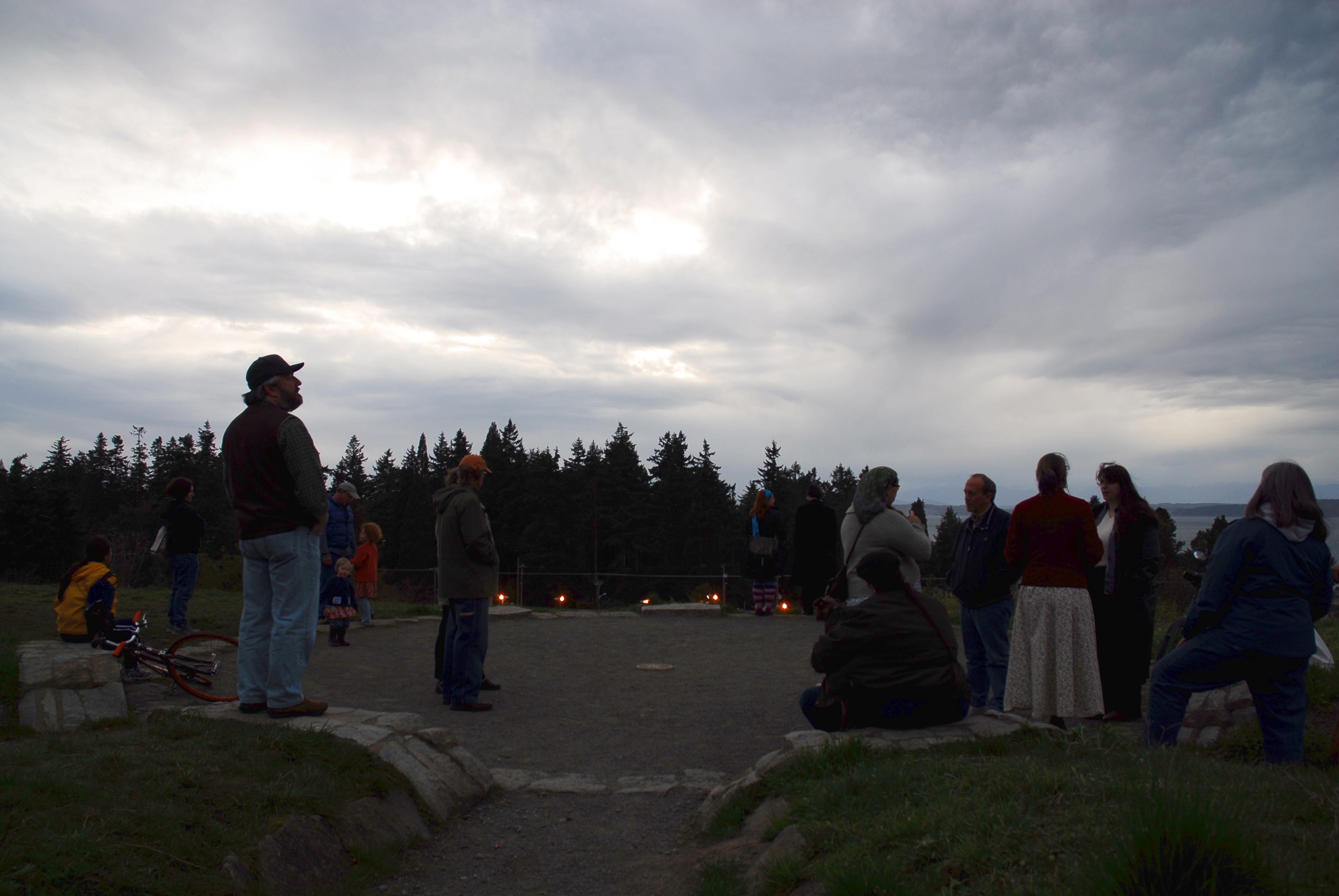
Waiting for the Sun - Photo Credit: Jason Ayres Gift Enevoldsen
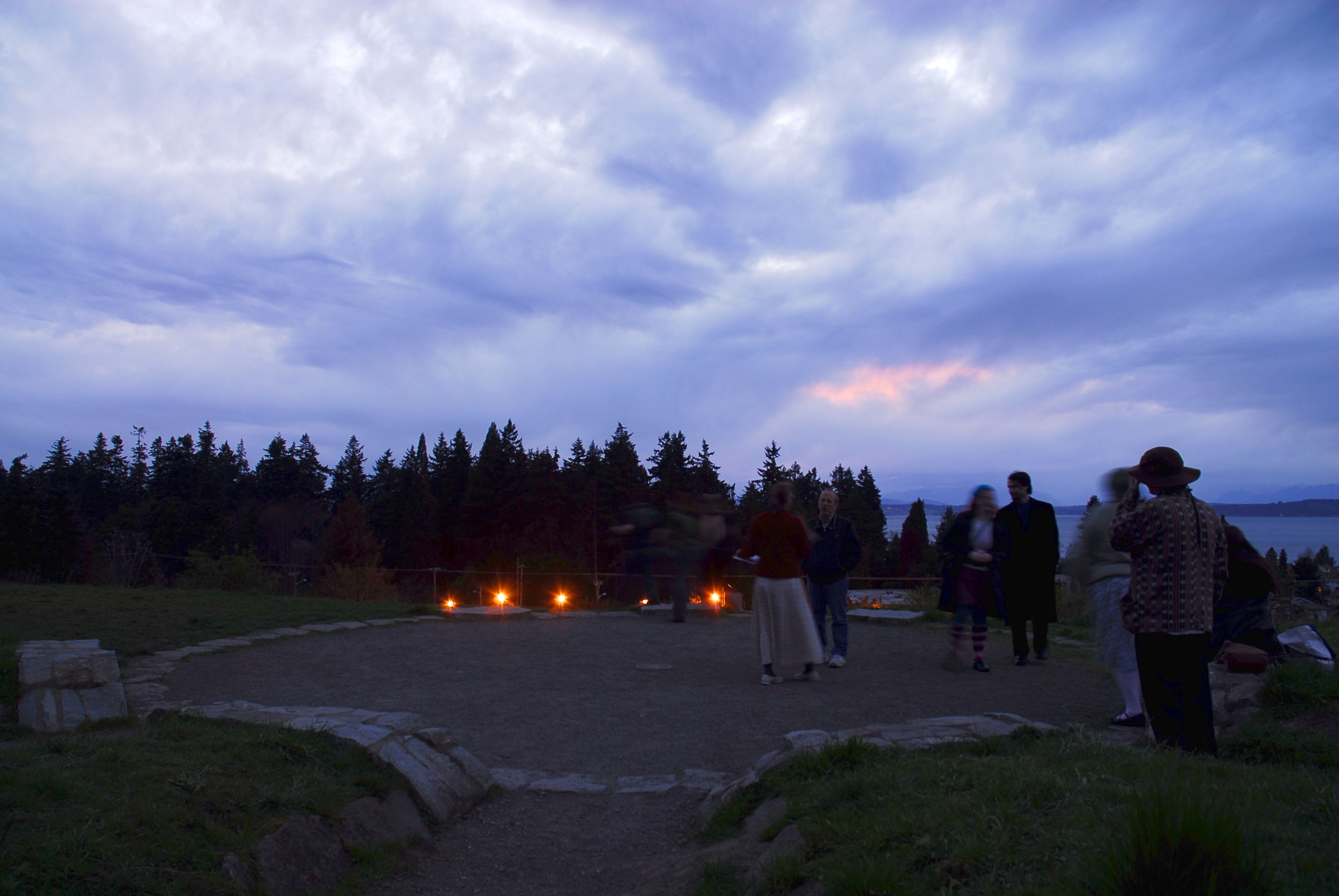
STILL waiting for the Sun to set - Photo Credit: Jason Ayres Gift Enevoldsen
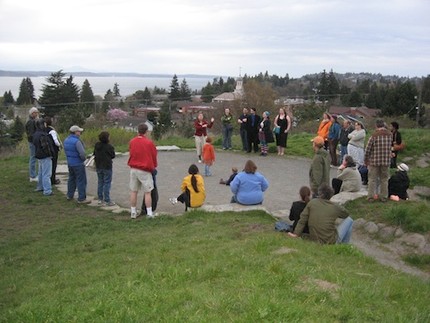
Talking with the crowd while we wait. Photo Credit - Greg Scheiderer
~ A l i c e !
Ada Lovelace Day Featuring: Pamela Gay
Pretty Printout
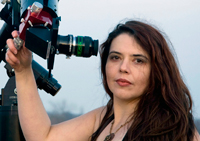
Yes, this is an actual photo of an actual astrophysicist. Why are you asking?
Good morning! Welcome to Ada Lovelace Day, a day where we celebrate women in technology (etc) through blogging.
I’d like to introduce you to a friend of mine, Dr. Pamela Gay, research astronomer, podcaster, gateway to science for the average Mr. or Ms. Doe, Skye-rider (that’s her horse), and internet-addict. Oh, and P.S. – you didn’t hear it from me but she has two X chromosomes. That’s right, she’s female.
Pamela Online
Although she does many things (in her own words, “Some days I suspect I wear too many hats. Other days, I know I wear too many hats!”) and I’ve heard tell she has a penchant for variable stars, Pamela’s research at the moment is focused online, and on how it is that internet users interact with astronomy content. She certainly has plenty of fodder for this research: her online projects include writing, voicing, and producing Astronomy Cast; masterminding 365 Days of Astronomy (you’ve heard me on there once, and you’ll hear me again in May); and being part of the Zooniverse team – a citizen science astronomy project. Oh, and of course she has a blog: StarStryder.
A la Twitter, I asked her to describe herself in 140 characters or less. I’m not sure I could do it, but she did:
I am a female scientist focused on communicating the majesty of the universe & the realities and struggles of academia one day at a time.
Teaching and Learning
No matter how much you enjoy your job, there are going to be at least a few days where you’d rather not get out of bed. A few tasks you just don’t want to face. On those days you focus on the part you love. For Pamela it’s easy to identify: “seeing students realize they can be more then they ever imagined and can do more with their lives than they ever dreamed,” she says. I have to agree. Watching a moment of understanding, seeing students achieve something they’ve fought for – that’s the reward for teachers.
It’s also why I admire Pamela’s work. Not only does she have the Ph.D. in Astrophysics, but she pushes back against the idea that this means she has to sit holed up in an office cranking through numbers and churning out papers. She teaches in as many ways as she can, even when colleagues choose not to treat that output as valuable (a judgment both teachers and women have to face fairly often).
Thing is, it’s people like Pamela who will influence the next crop of astrophysics researchers. It is people like Pamela who will convince students that they can become the next Nobel Laureate or the next Carl Sagan or the next professor of Astronomy. And she’s not “just a teacher,” she’s published – over and over and over again. She’s documented her influence scientifically.
Only Human
Sometimes it seems like the women we look up to have superpowers. Guess what? Einstein and Annie Jump Cannon were human, and so is Pamela. She might have caffeine running through her veins rather than blood, but she makes time in her life for her husband, horseback riding (did you hear that girls near the age of seven? You can be an astrophysicist and also continue to love horses!), gardening, and renovating her house.
So, listen to her next podcast and enjoy it, whether you decide to go into astronomy research or not. If you do decide to head in that direction though, “open doors for yourself by playing with technology,” says Pamela. You’ll be able to use the experience. Take some programming classes, some math classes, and definitely learn to write – if you can communicate your ideas you’ll be able to show people why what you do is cool, and you’ll be able to convince folks to give you funding.
Want More?
Last year I blogged about Susan Sakimoto, and mentioned a lot of other people I admire and respect:
I always have trouble deciding who to write about. There’s Ada herself, of course, and Annie Jump Cannon, Cecelia Payne-Gaposhkin, and Williamina Fleming. And then there are the current scientists (most of whom you’ve never heard of because you tend not to get famous until you’re dead or almost dead): Hannah Jang-Condell, Susan Sakimoto, Andrea Dobson, Pamela (the list goes on and on and on). Not to mention my students or the faculty and grad students I’ve met at the University of Washington. Students are really important and really inspiring – except when they’re slacking off. You can see some women in science I’ve met (as interviewed by two high school interns last summer) over at the Scientists Like Me project – which will eventually become part of the We Are All Astronomers project (another Pamela special).
~ A l i c e !
Carnival of Space & Link
Pretty Printout
If you’re not currently subscribed to my new feed through feedburner you should be. It’s easy just click here, or click the orange box at the top of the page near the search bar, or input http://feeds.feedburner.com/AlicesAstroInfo into your favorite RSS feed reader.
Onward:
Carnival of Space #146 is live at Simioastronomy – check it out, lots of Hubble goodness.
Also, Seattle Astronomy Examiner Greg Schneiderer reports on my Equinox Sunset party from Saturday evening. He’s got photos in case you missed it.
~ A l i c e !
Hubble 3D vs Life
Pretty Printout
I went to see the press preview of Hubble 3D at Pacific Science Center’s Boeing IMAX Theater. It’s opening on March 19th (2010) – tickets here. Full disclosure, in case you were unaware, I am employed by Pacific Science Center but my comments here are my own.
I have been looking forward to this film for months, and I was struck by the similarity to some of what I do. So, if you will excuse the conceit, I would like to share a double story with you.
Hubble
Hubble 3D is partially just plain fun: fly-throughs of actual beautiful Hubble images, three-dimensionalized by some very talented folks who worked with some very intelligent astronomers to be as accurate as possible. As much as I love Hubble images, the other part of the movie is what I enjoyed most. The story of how to fix an ailing telescope, 350 miles above the Earth’s surface. I’ll give you some hints – but go see the movie for yourself to get the full story of the repairs to Hubble.
A Day in the Life
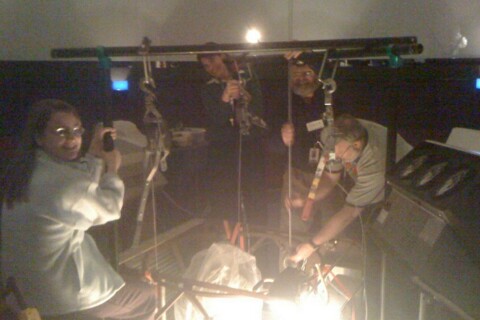
Then there’s what I do. In November, the planetarium projector also chose to show its age. On its way down the elevator shaft it slipped the last six inches and refused to budge. This was extremely scary for all of us, and after several calls to the techs in Pennsylvania we decided we needed to winch it up.
Here’s where it gets similar to the Hubble mission. Compare these two pictures:
|
That’s Astronaut Mike Massimino in the center, with his head stuck up in the bowels of Hubble. Astronaut Mike Good’s hands are in the lower right, holding a tool that looks like a drill with a long bit. |
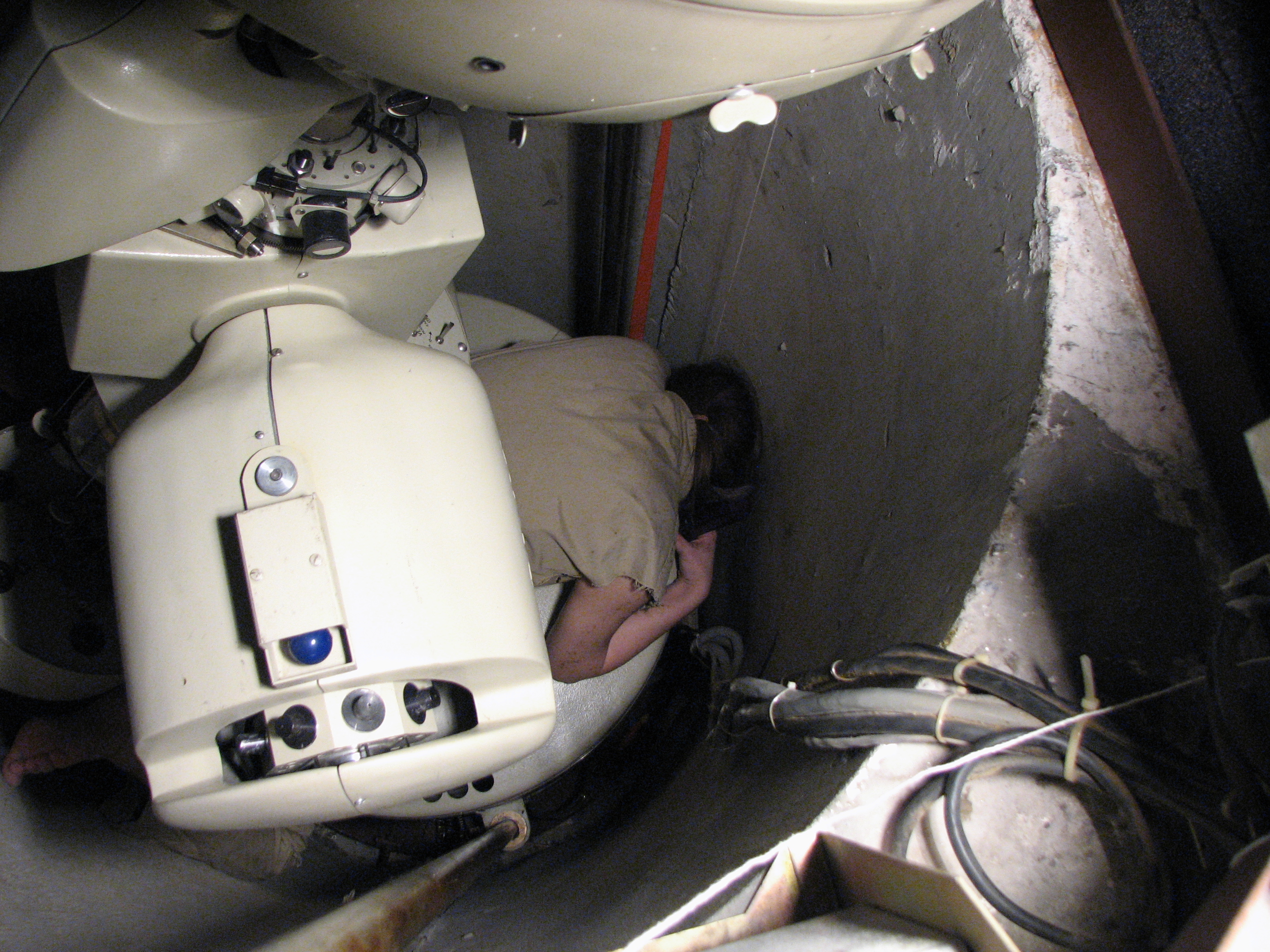 And this is me. Five feet down an elevator shaft that’s about three-and-a-half or four feet in diameter, trying to reach down another two and a half feet to unhook a chain. And this is me. Five feet down an elevator shaft that’s about three-and-a-half or four feet in diameter, trying to reach down another two and a half feet to unhook a chain. |

The astronauts on STS-125 had quite a lot more to contend with, they were wearing space suits, the stakes were higher, their equipment larger and more expensive, but we both succeeded through teamwork, specialized tools, perseverance, and time.
Nemeses
Ah, and then the equipment just seemed to fight back:
|
This is not the handrail that Astronaut Mike Massimino had to break off, but it looks very similar and I can’t find a photo online of the broken one. |
This chain and sprocket caused a day and a half of work for several people. Arrrgh! But, we succeeded! |


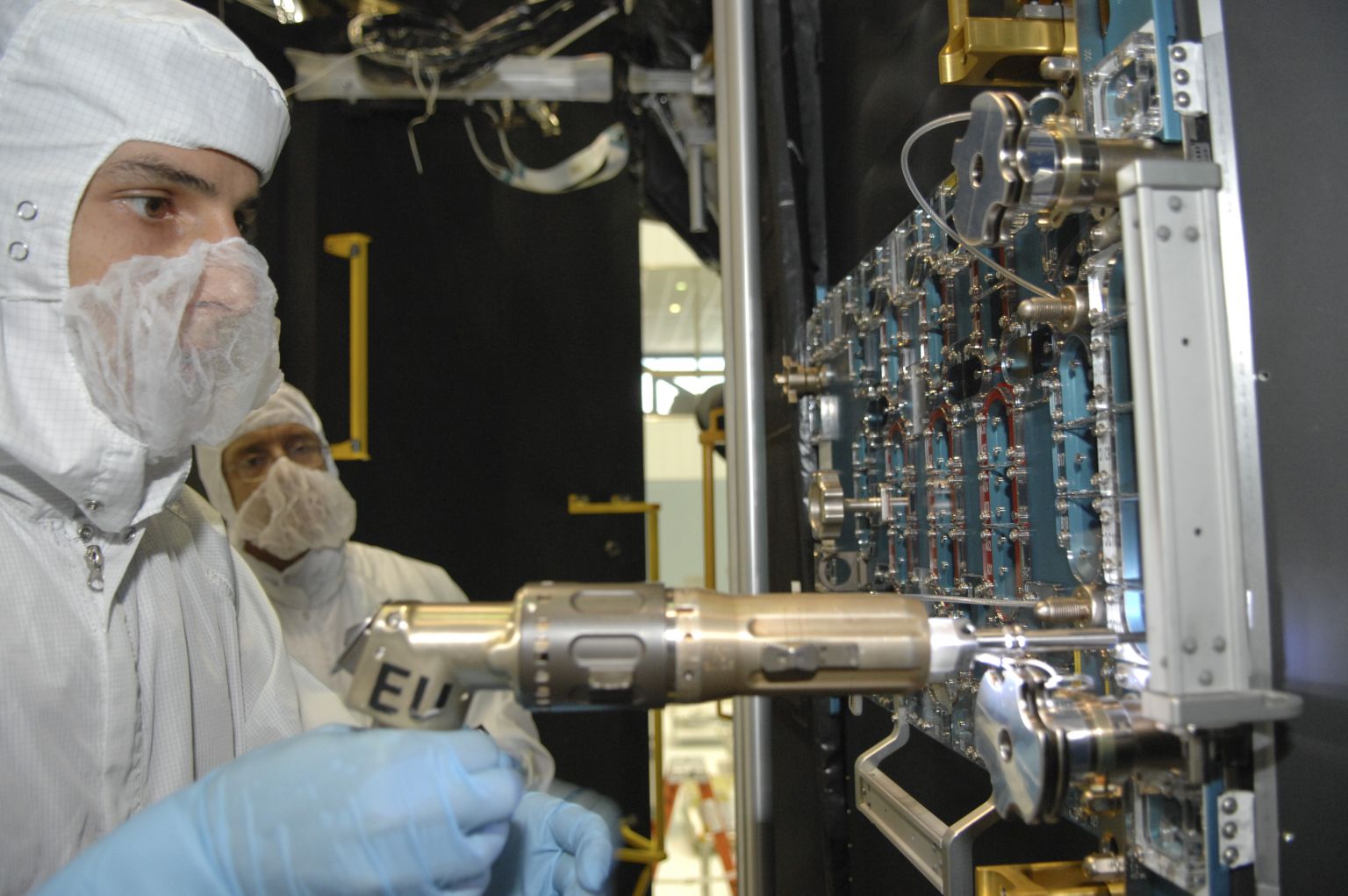
Specialized Tools
|
In order to safely remove small screws in space, and be able to manipulate power tools while wearing gloves, they developed some very specialized tools for the Hubble repair missions. |
 Well, we were inspired by this – but Mark made a tool very similar, but with a slightly pointier point. Unfortunately, that tool is at the bottom of the elevator shaft now, so I can’t show you a real picture. Well, we were inspired by this – but Mark made a tool very similar, but with a slightly pointier point. Unfortunately, that tool is at the bottom of the elevator shaft now, so I can’t show you a real picture.
(Coat Hanger credit: Demion on Flickr) |
Teamwork
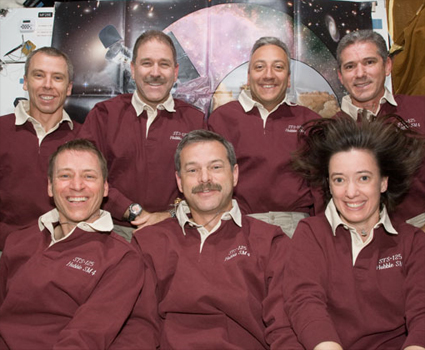 This is the team, and this is their poster: 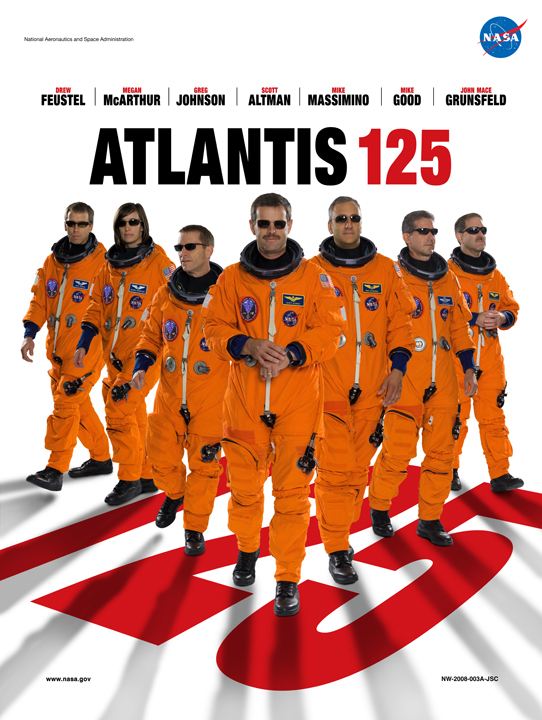 I love it. I love it. |
Gary Kezele made the commemorative sketch.
|

Want More?
Hubble 3D in IMAX – the newest IMAX space movie.
See it in Seattle (Use this link until March 19th) (Use this link after March 19th)
~ A l i c e !
P.S. All astronaut photos are from NASA. As you might expect.
Spring Equinox Sunset – 2010
Pretty Printout
- When: Saturday, March 20, 2010 at 7:22pm (so come at 6:50pm)
- Where: Solstice Park (or, if you’re not in Seattle, wherever you have a view of the western horizon!)
- Who: Everyone welcome. as usual.
- This event is my part of NASA’s Solar System Ambassadors program, so if you have questions about NASA missions, bring them and I’ll do my best or direct you to somewhere that can answer!
Come watch the spring equinox sunset Solstice Park in West Seattle on Saturday. We’ll see if the sunset lines up with the placed marker. I’ll be there even if it is cloudy because sometimes the Sun peeks through just as it begins to set, but if it is driving rain or sleet I’m staying home with a hot cup of tea.
If you’re interested – here’s the timing of various celestial events on Saturday from Seattle, courtesy of the U.S. Naval Observatory Astronomical Applications Department
Sun and Moon Data for One Day
The following information is provided for Seattle, King County, Washington (longitude W122.3, latitude N47.6):
Saturday 20 March 2010 Pacific Daylight Time
SUN
Begin civil twilight 6:41 a.m.
Sunrise 7:12 a.m.
Sun transit 1:17 p.m.
Sunset 7:22 p.m.
End civil twilight 7:53 p.m.
MOON
Moonrise 8:21 a.m. on preceding day
Moonset 12:11 a.m.
Moonrise 8:55 a.m.
Moon transit 5:02 p.m.
Moonset 1:19 a.m. on following day
Everyone is welcome, see you there!
P.S. Thanks to West Seattle Blog for publicizing the last few! If you don’t know them, they are a great way to keep your finger on the pulse of our not-so-little peninsula.
~ A l i c e !
Last-Minute Stargazing Tonight – West Seattle
Pretty Printout
I declare it is time for another last-minute star party in West Seattle. This will be my second event as one of NASA’s Solar System Ambassadors.
- Tonight, Saturday, March 6, 2010
- Start: 9pm – I may leave around 10 or 10:30 unless no one shows up.
- Solstice Park as usual (at the TOP, if you’re by the tennis courts go up)
As always, this is if the weather is permitting. If you can see stars I’ll be there (unless it gets really super freezing cold).
Telescopes – Mars first, Saturn later?
I’ll bring a couple telescopes, you should bring one if you have one. We’ll look at Mars definitely, and maybe Saturn if it comes up over the trees in time.
Unfortunately, we’ll miss seeing the international Space Station, but if you wanted to step out of your house earier, you can see it around 7:47pm, starting West-Southwest.
| Date | Mag | Starts | Max. altitude | Ends | ||||||
| Time | Alt. | Az. | Time | Alt. | Az. | Time | Alt. | Az. | ||
| 6 Mar | -3.1 | 19:47:37 | 10 | WSW | 19:50:30 | 62 | NNW | 19:50:32 | 62 | NNW |
GLOBE at Night
This would be a perfect opportunity to get your GLOBE at Night observations in. Wait, you don’t know about GLOBE at Night? Well check this out – you can help out on a worldwide science project to determine how stargazing quality is changing around the world. Plus, I’ll be around to help out if you need it (but I don’t think you will). The Lat/Long of Solstice Park is (47.536341, -122.39052).
See you tonight!
~ A l i c e !
March-April 2010 Sky
Pretty Printout
Upcoming Events
March 3-16, 2010 – GLOBE at Night
The annual citizen-science stargazing event is back! Go outside any one of the above dates and take a look at Orion – no telescope or binoculars needed. GLOBE at Night wants to know how many stars you can see with just your eyes. But wait! They make it easy – you don’t have to count the stars – just compare what you see to diagrams, and pick the one that matches and submit your observations online. This data will be compiled into maps which will help astronomers track light pollution and how stargazing quality in various parts of the world.
Go to their webpage, download an observation packet, and take your family out to your backyard for some real science!
You’ll need to know your latitude and longitude:
Seattle is at: 47°37’N, 122°20’W
8:30pm Saturday, March 27, 2010 – Earth Hour
All you have to do for Earth Hour is turn off your lights – especially your outdoor lights for one hour at 8:30pm on March 27th. It’s that easy. Earth Hour is about awareness of energy conservation and climate change – with the added benefit of supporting Dark Skies Awareness and making stargazing awesome even in big cities.
You can sign up and get more information, or just turn off your lights. Tell a friend; ask your neighborhood businesses to participate. Anything you do helps.
Constellations and Observables:
Notable Sky Objects
MARS
Mars is high, bright, and beautiful in March and April. Look for a bright reddish star near the zenith – or check the starmap above for more detail. Mars was just at opposition a month ago, so now is still a wonderful time to look at it.
SATURN
Saturn is also high in the sky as the night wears on, rising later than Mars, but visible most of the night.
JUPITER, MERCURY, VENUS
Jupiter, Mercury, and Venus are all too close to the Sun to be visible.
New Constellations
BOÖTES – The Herdsman
SCIENCE: Arc to Arcturus, Speed on To Spica. This is how you find Boötes using the curve of the handle of the Big Dipper – and then that leads you on to Spica in Virgo!
Tau Boötes (sorta Boötes’ left foot) has an extrasolar planet! One of the so-called hot Jupiters. You can see this star just to the right of Arcturus – it’s the crook (corner) star off the little triangle that you’ll see there.
MYTH: The modern myth is that Boötes invented the plow, and therefore farming, and he’s the only “regular person” up in the sky – everyone else is a God, or partially Godlike, or something. I love this myth, because I can explain that Boötes is why we have cell phones and planetariums. It turns out that several different cultures depict Boötes as a herdsman or a farmer: the Saudi Arabians, the Egyptians (to whom the Herdsman is so important he also represents Osiris), the Greeks, and the Christians. Yowsa.
VIRGO – The Virgin (or “Princess”)
SCIENCE: Arc to Arcturus, Speed on To Spica. This is how you find Boötes using the curve of the handle of the Big Dipper – and then that leads you on to Spica in Virgo!
We are part of the Virgo Cluster Supercluster of galaxies – and it’s called the Virgo Supercluster Cluster because to see the rest of the galaxies in our group you look towards Virgo. There’s a bunch of beauties out there by Virgo’s face, so if you’ve got a scope, take a look, and if you don’t, look up some pretty pictures of our group of galaxies – most of them are over there.
MYTH: Worried about talking about virgins in mixed company? Well, princess is a perfectly acceptable way to talk about Virgo, also “girl” is good too. If your audience is up to it, you might mention that this virgin usually represents the Greek goddess of justice – so I wouldn’t try to cross her if I were you.
CORONA BOREALIS – The Northern Crown
SCIENCE: There’s not much too Corona Borealis, but it is a very noticeable grouping of stars, and therefore quite helpful in finding Hercules, especially in our murky Seattle skies.
MYTH: Obviously the Greek myth is about a crown, but the Housatonic Native Americans call this Ursa Major’s cave!
HERCULES – Hercules
SCIENCE: Do not miss M13 – the Hercules Globular Cluster! This is one of the oldest groups of stars in our galaxy – it’s like the old-folks home of stars.
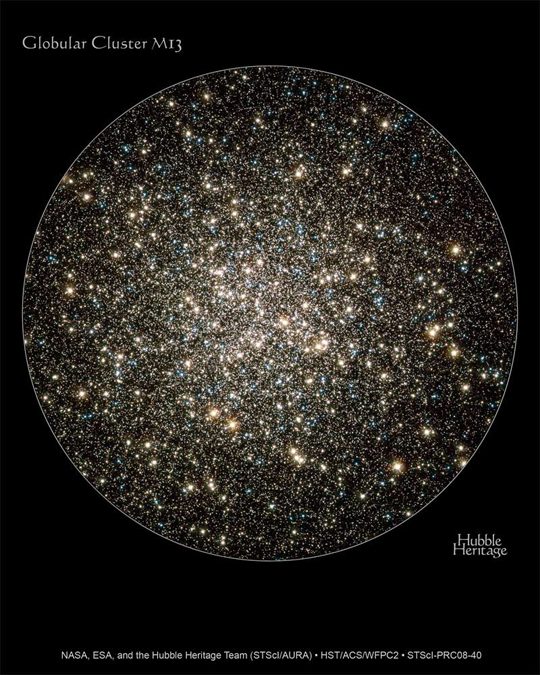
Hercules Globular Cluster by the Hubble Space Telescope
MYTH: “Hercules is one of the oldest constellations, found in the cave drawings of primitive cultures. Not even the Greeks were sure of his origins. We are aware that very early cultures worshipped him, but who and what his starry figure stood for is a mystery.
“About 300 BC the Chaldeans said that this figure was standing victorious on the head of a twisting serpent. They associated these two figures, Hercules and Draco (the serpent) with their sun god, Ishdubar.
“The Chinese called Hercules ‘Titso’ or ‘the emperor’s seat’.” (From Zeta Strickland)
“Tiny” Guys
Going for the Gold? Here’s this month’s itty-bittys.
SERPENS – The Serpent
LYRA – The Lyre (just starting to peek up)
CORVUS – The Crow
CRATER – The Cup
COMA BERENICES – Berenice’s Hair
CANES VENATICI – The Hunting Dogs
LYNX – The Lynx
SEXTANS – The Sextant
HYDRA – The Sea Serpent (Big and dim, so big that it’s close to being biggest Northern Hemisphere constellation)
ANTILA – The Air Pump (Maybe you’ll see it, but it might be too far south)
MONOCEROS – The Unicorn
LACERTA – The Lizard
LEO MINOR – The Small Lion (Between the Big Dipper and Leo)
CAMELOPARDALIS– The Giraffe
Returning Constellations
LEO – The Lion
CANCER – The Crab
CANIS MAJOR – The Big Dog
ORION – The Hunter
TAURUS – The Bull
GEMINI – The Twins
CEPHEUS – King Cepheus
DRACO – The Dragon
URSA MAJOR – The Great Bear
URSA MINOR – The Little Bear
CASSIOPEIA – The Queen
Happy Sky Viewing!
Where’d I Get My Info?
My memory, and Zeta Strickland
~ A l i c e !