Archive for the ‘AstroInfo Article’ Category
 Density Waves: What’s Up with Galactic Spiral Arms?
What’s up with the spiral arms of our galaxy?
The short answer:
This is awesomely weird. Imagine a bike wheel – each spoke is an “arm.” When the wheel rotates, the arms rotate, right? This is NOTHING like our galaxy. Imagine a beanie hat with a propeller on top. Hold the propeller still, and spin the hat underneath. That’s a little more like it. The hat is the stars, dust, gas, and everything our galaxy is made of. It spins around, passing THROUGH the arms (the propeller) of our galaxy. The arms aren’t made of anything. Whoa, what?
Okay, interested? Confused? Ready for more? Good, because that wasn’t a very accurate description, it was just enough to make you think.
Arms are Denser Areas
When I said “the arms aren’t made of anything” that’s because they’re just denser areas of the same stuff the whole galaxy is made out of, but as the galaxy spins, the arm is made up of different stars, different dust from one eon to the next. The stars and stuff glide right through the arms, though they may slow down while they’re there.
Try this at home:
- Take a face-on mug shot of your favorite spiral galaxy (how’z about the Milky Way?)
- Mark your 1000 favorite stars in one arm.
- Wait 100 million years.
- Take another photo.
- Find those 1000 favorite stars, and where the arms are now, compared to before.
- The arms may have moved a bit, but the stars will have moved a LOT. Some of them will be halfway around the galaxy again, some will only have moved a touch, and still others may have gone around a couple times. The arms will now be made up of different stars, but they’ll still be there.
Okay, obviously you can’t really do this at home for about 10 very good reasons, but you get the idea.
Stars Travel through the Arms (Traffic Jam)
Think about it another way. Spiral arms are like traffic jams of stars. You know how there’s always a traffic jam at the Renton S-Curves, or by the U District on I-5? If you take either of these routes, you’ll be in the traffic jam for a while, and then once you’re out of the bad area, you can get back up to speed. The traffic jam is still there though? (usually true … we’re talking about I-5 here), but you’re out, it’s someone else’s turn to bite their lip and grumble at traffic.
Same way with stars. The traffic jam is always there, but different people are in it at different times.
There’s a PERFECT animation over at: Traffic Waves.
Density Wave Motion
Now that we’ve established that spiral arms are density waves (technically a “spiral density wave”), and it’s the stars that move through it, not the arm spinning around like a bike wheel, I’ve got a shocker for you. The arms move too, just at a different speed. That’s called the “pattern speed.”
Watch this video – see how the traffic jam moves around the circle, but the cars move differently?
Now this one – it’s a little easier to see both motions with this spinning galaxy.
Density Wave Formation
How do the spiral arms get started? Umm… that’s an open question, but I can tell you a couple of useful things.
First – the galaxy rotates differentially. Oops, jargon. The middle rotates at a different speed than the outer edge. Ta-da! Differential rotation. The Sun and Jupiter do this too. A bicycle wheel does not.
This differential rotation is due to Kepler’s laws. objects closer in revolve around the center a lot faster than objects further out.
Second, the likelihood that the galaxy started as one big perfectly even ball of gas is pretty low. There were pockets of lots of gas, and pockets of less stuff. These pockets will spread out and spin into denser areas.

Galaxy Rotation
So that’s a pretty easy explanation. There are still some problems we need to solve, but that should give you an idea.
Lastly, a way in which the arms keep themselves dense is due to the gravity of more material in the arm itself: stars speed up as they enter and arm, and then slow down as they leave it – the opposite of a traffic jam.
The Wind-Up Problem
But how come the arms don’t twist themselves up? Well, that’s one of the problems with the formation hypothesis I just showed you. This is the question that led to the idea of density wave arms in the first place.
It doesn’t twist itself up because the arms are not made of material, they’re just a denser area, there’s no reason for the arm to change.
Want More?
Astronomy Cafe has some really useful, deep answers.
Check out Voyages to the Stars and Galaxies by Fraknoi, Morrison, and Wolff
Carnival of Space #76(?)
Is hosted over at As(si)tronomi! (in Egypt!) Oops, actually, I think Assi herself is in Egypt temporarily, but if I’m reading the signs (.se) correctly, she and her blog are based in Sweden. That would explain the umlauts in her other blog entries.
Icon Competition!
Hey y’all!
See that 8-bit blond girl behind the “AstroInfo” desk that adorns much of my AstroInfo correspondence? Well, she’s cute, but she’s a little generic, and she doesn’t fit in some places (like my banner). I generated her with one of those avatar makers. She’s got glasses, she’s blond-ish, she clearly likes stars, and she’s clearly the author of AstroInfo – but … she lacks something.

Alice
So, it’s time for a competition! I need a new AstroInfo logo/avatar. I know at least six of you out there are great artists and logo-designers, and I’m sure there’s more I don’t know so well.
Guidelines:
– Must scale well to 128px by 128px
– Must be family appropriate
– Preferably it’ll scale up to ~400px by 400px for printing
– If you use fonts, convert them to outlines, so I don’t lose them (and tell me which font you used so I can perhaps use it in other titles and such)
– File formats: .jpg, .ai (CS3 or earlier), .psd, .pdf (if you must, but I’d like some flexibility), ask about others … oh, I’d prefer it submitted digitally, but paper submissions will be entertained.
– CC license it, at least to me. (I need to be able to make alterations, such as text stuff)
– Not an actual photo of me.
– If you give the name of the blog it is correctly referred to as “Alice’s Astro Info” (two spaces) or “AstroInfo” (no spaces)
Suggestions:
– I like the fact that she’s a person, and a girl who vaguely resembles me.
– She and I both LOVE STARS!
– Blue is an awesome color – but then again, all colors are pretty. (P.S. There’s blue in my hair)
– I’m open to all media – photos, drawings, comic-style, realism, clay … as long as you take a picture of it and I can use that … whatever.
– I’m usually not much of a fan of abstract, unless it’s full of triangles.
Extra Credit: A related banner!
– Aspect ratio of 770px by 200px
What You Win
– The competition
– My gratitude and excitement
– International recognition (hey, I have at least one reader in Portugal!)
– $0.00
– I’m willing to entertain reasonable suggestions for other compensation, but no guarantees.
– If you want them, I can arrange for free tickets to Pacific Science Center, but you have to tell me you want them. If you want tickets to see Lucy’s Legacy you’ll have to also tell me a compelling reason why I should give my comps to you and not to my parents … but we’ll see what we can do.
Judging
– Solely by me. I get to pick, and I don’t guarantee I’ll be fair.
– I promise I’ll look at anything that’s sent to be before November 10th, 2008.
Email me at [the name of this blog] with no spaces, apostrophes, or punctuation {at} gmail
Thank you!! :-)
Snow Falling on … Mars
The Main Idea:
The Phoenix Mars Lander’s weather instrument (a LIDAR – like radar, only with a laser) detected snow falling from clouds above the Phoenix Lander on 9/29/2008. The snow sublimed before it hit the ground, but we’re in Seattle, we’re used to celebrating snow that doesn’t hit the ground.
More?
I know, I’m sorry, I’m really late posting this. But this is a “Mars has Water!!” discovery that I actually think merits some kerfuffle (of the last eight I think there have been about two of discoveries that do).
So here’s the thing – we’ve known for since forever that there is ice on Mars (though we verified it in 1970), and in 2006 we saw evidence of water that had actually been flowing within the last year. All the other announcements are varying levels of confirmation of these facts. For instance just a month or two ago, Phoenix watched ice subliming. Before that, the various rovers and landers have imaged clouds (that include H2O) in Mars’s atmosphere.
This is DIFFERENT. This is the missing section of the water cycle – not water on the surface, not water evaporating or subliming, not water in clouds, but water falling back down again!
So, if that closed the water cycle what are we still waiting to find? We still want to see liquid water, and I wouldn’t mind seeing some of that falling snow actually hit the ground, but I’m not going to hold my breath for that one.
More Posts About the Snow:
Bad Astronomy: Snow Place like Mars
Universe Today: Snow is Falling From Martian Clouds
Martian Chronicles: Phoenix Sees Snow and Carbonates on Mars!
The Press Release:
Planets and Moons (from the BA)
“Wow, what a day. Great day to get out in the park and meet some new planets in this JANUS YOU STOP THAT RIGHT NOW beautiful solar system. Really, you work all week, on a Saturday you just need to enjoy the TETHYS GET OFF OF PANDORA GET OFF GET OFF TETHYS NO JANUS DON’T YOU GET INVOLVED TETHYS GET OFF GET GET little bit of relaxation. Maybe I’ll get to see that little blue-green number out by COME ON PALLANE COME ON STOP SNIFFING COME ON I HAVE PLACES TO BE Mars. Hope I don’t run into Uranus, though. He’s a nice enough guy but all those toilet jokes, jeez. Wow, I thought it was going to be cold, but the sun is IAPETUS GET OFF THAT COMET I’m so sorry, ma’am IAPETUS NO WAIT TETHYS YOU LEAVE PANDORA ALONE NO JANUS I SAID GET DOWN DIONE TELESTO NO IAPETUS Oh, no, is that Terra, KIVIUQ DO NOT GO OVER THERE NO KIVIUQ IAPETUS DON’T ENCOURAGE JANUS ALL OF YOU STOP THIS RIGHT NOW BEBHIONN SKOLL HYRROKKIN THAT’S IT ALL OF YOU ARE GOING TO THE POUND YOU HEAR ME THE POUN-
Oh, hey, Terra. Moons, huh? But you gotta love ‘em anyway. They’re a planet’s best friend.”

Buy one of your own … or buy one for me (hint hint!)
The Next Carnival of Space (#73)
If you enjoyed last week’s Carnival of Space – check out this week’s over at Kentucky Space!
NEW Images from Mercury!!
The Key Stuff:
Woo hoo! New images of Mercury!
The way I’d introduce this and interpret it in the planetarium is just to ask questions about it, and collect visitor hypotheses. That’s all the scientists have right now: questions. They also have some hypotheses about bits of it, but they haven’t had time to think of ideas for everything, and even less to test or analyze those ideas.

Mercury Credit: MESSENGER
What’s up with those longitudinal lines?
Why are those rayed craters so bright?
Some of those craters are on the lines, why?
Is that Mercury’s North pole at the top?
What causes lines like that on other planets?
Here’s some background to help you with your analysis.
Rays:
As we know from the Moon, rays often emanate from craters – especially new craters. When the meteor impacts, it sprays up a bunch of regolith (surface rock/dirt) that falls down in a rayed pattern. Go stomp in a puddle. Watch what happens – that’s what I’m talking about.
Bright Craters:
Brighter craters are almost always newer. The rock is newly broken, showing “shiny” un-weathered, un-covered, un-eroded faces to the sunlight which bounces back at us.
North and South:
According to the MESSENGER press release, that is the North Pole of Mercury up there at the top with a crater on it.
Longitudinal Lines:
The MESSENGER team has floated the idea that these are rays from that Northern crater. They know more than me, but that seems to me like a long way for ejecta (the kicked up regolith) to go. A really long way. How hard would that impact have had to be? Would Mercury’s gravity be enough to pull that ejecta back?
Want More?
Emily promises to have a post up soon.
Phil’s already chatting about it.
My Source.
P.S. Phil’s wrong. It’s not a watermelon. It’s a pumpkin, and I have incontrovertable proof:
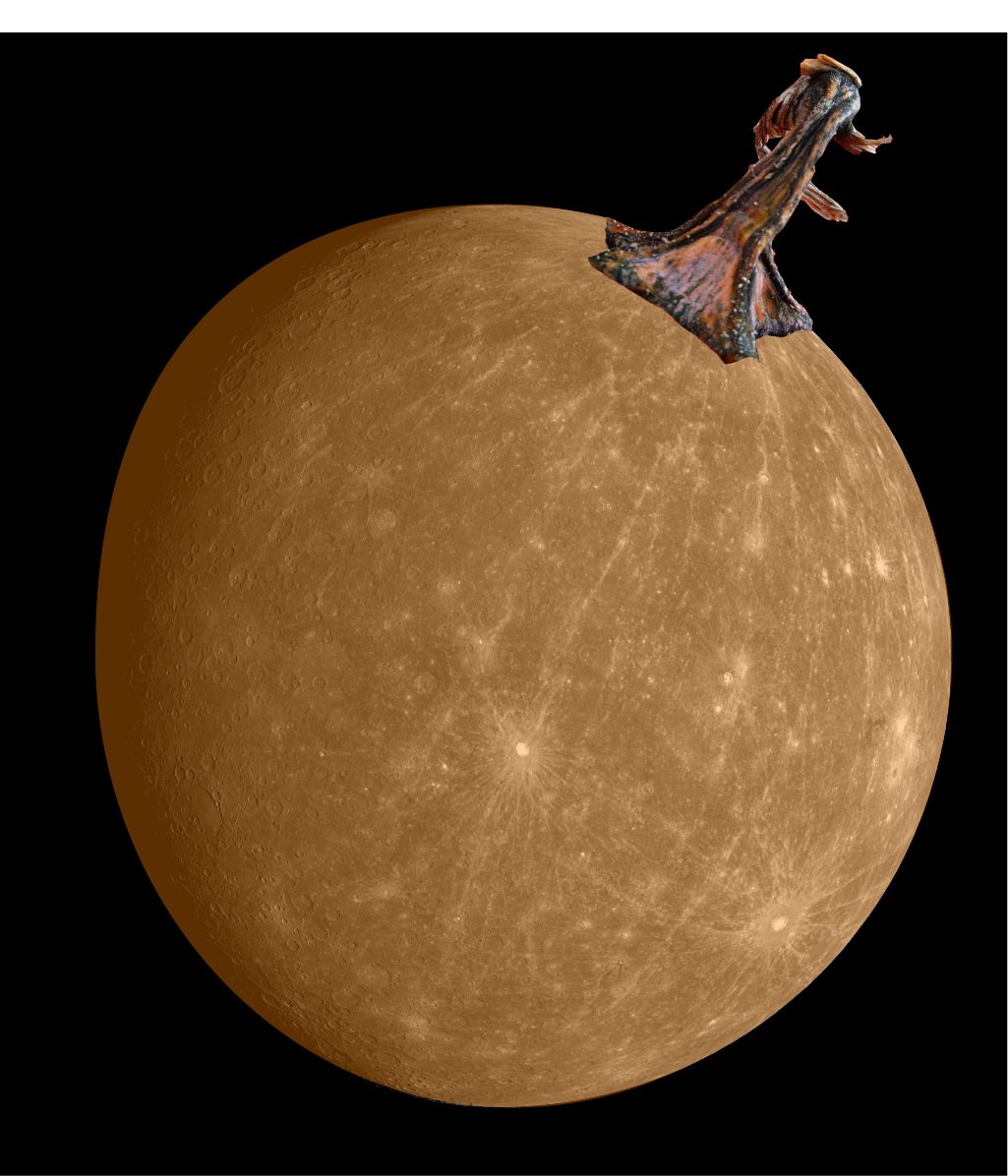
Mercury is a Pumpkin
Carnival of Space: October 2, 2008
In celebration of NASA’s 50th Anniversary, this week’s Carnival of Space is in the form of an acrostic.
H – Hills and what they have to do with moons are discussed by the Bad Astronomer over at Bad Astronomy
A – All’s quiet on the solar front, should we be worried? Alan Dyer of What’s Up Astronomy says “Nope.”
P – Posted by Space Video of the Day: the Falcon of SpaceX achieves orbit!
P – Poor Galileo – his saga is like a Mexican Soap Opera, or so claims Dr. Bruce Cordell of 21st Century Waves.
Y – Yummy planetary science from Maria Brumm and Green Gabbro.
B – Back in 1989 a program called Lunar Oasis was proposed, and David Portree examines it over at Altair VI.
I – Interstellar flight in a long-term context. Paul Gilster analyzes the survival of civilization and expansion into the cosmos over at Centauri Dreams.
R – Research the history of the NASA meatball and worm with Astroprof this week, in celebration of NASA’s 50th Birthday!
T – Trouble comes to Hubble, and Steinn Sigurðsson of Dynamics of Cats takes a look at what the problem is.
H – Huge telescopes held in place by magnetic flux pinning and other giant mirrors are approached by Next Big Future.
D – (the) Death of a Martian moonlet is exposed by Ryan Anderson Briony of Martian Chronicles.
A – Approaching martian winter, Ray Villard of CosmicRAY talks about Phoenix’s limited future and extensive past discoveries
Y – You know analogies always help, so Wayne of Idea Festival reviews J. Richard Gott’s discussion of the Space Colonization Imperative, and how it’s similar to basketball and the Titanic.
T – To NASA! 50 years of exploration and collectibles, discussed by none other than collectSPACE.
O – On counting stars and cells – Ethan Siegel of Starts With A Bang wonders which is bigger, the number of stars in a galaxy, or the number of cells in the human body
Y – Yikes! Watch out for unruly astrophysicists wielding calculations over at the Lounge of the Lab Lemming (by Dr. Lemming)
O – Oh my, iPhone apps galore – including an awesome Starmap & Planetarium app reviewed by Flying Singer in Music of the Spheres.
U – Universal Babe (I mean, A Babe in the Universe!) discusses Hubble’s difficulties this past week.
D – Decelrating oddly, the Pioneer spacecraft are veering off course. Twisted Physics’ Jennifer Ouellette looks at why.
E – ESA’s new Planck spacecraft‘s plant (oops, typo) plans to look at the Cosmic Microwave Background Radiation is discussed in detail by dj at OrbitalHub.
A – Accretionary Wedge, the carnival from the Geoblogosphere was hosted this past week. Check out GoodSchist’s artwork about Geology in Spaaaaace.
R- Research meets poetry with “Endeavour Calls” by Stuart Atkinson of The ‘Verse.
N – Nuclear decay rates, are they related to the distance to the Sun? Ian O’Neill of astroENGINE tackles this question, by looking at the Cassini mission.
A – “Action on Asteroids!” says Alan Boyle in Cosmic Log.
S – Shubber Ali of Space Cynic is interviewed on The Space Show.
A – Anniversaries (specifically NASA’s) are celebrated over at Potentia Tenebras Repellendi by Alexander Declama
! – !! I wish I had an “M” for Emily Lakdawalla’s Monday Mercury MESSENGER Madness in the Planetary Society Weblog!!
That’s it for this week! Tune in somewhere else to next week’s Carnival for more – or go to Universe Today’s Carnival of Space page to learn what it’s all about. Thanks for your entries, and thanks for your help, Fraser!
What Telescope Should I Buy?
I get asked this question regularly. I wish I could just say “learn enough about telescopes and the night sky so you can answer that question yourself,” but that advice is ignored because it is unsatisfactory. If you press me for an answer, this is what you’ll get.
Half of this is from guest blogger Keith Enevoldsen (my dad!) who didn’t know he was writing for this blog when he wrote these words, but it is sound advice and well worded.
Your First Telescope:
Whatever you do, don’t buy a scope that “looks like a telescope.” What I mean is, if it looks like a long thin tube, or you can picture Galileo using it, it’s the wrong thing. You want something short and fat. “Willowy,” “elegant,” and “sleek” are not the right words to describe the right telescope.
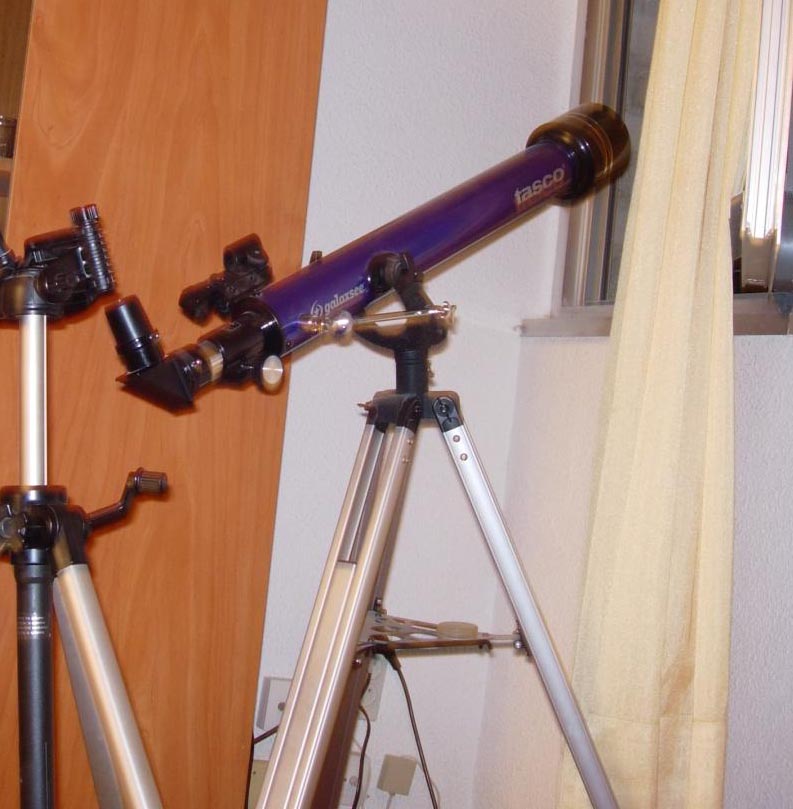
This is wrong (image courtesy of _guu_)
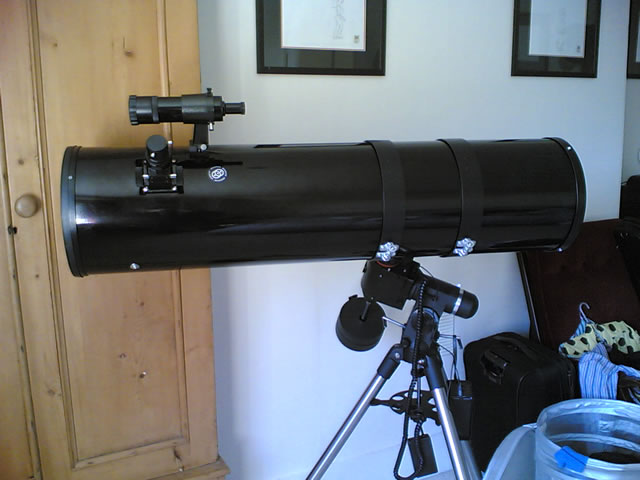
This is right (image courtesy of vbloke)
Price:
Telescopes less than about $200 generally have poor optics. If you want to go much below about $200, then get some quality binoculars instead.
AstroScan:
My favorite beginner telescope is the Astroscan from Scientifics. It is about $200. It’s cute and fun and simple. It has a very wide field of view (as opposed to very high magnifying power) and a ball-shaped bottom, so you can point it by simply moving it with your hands — no fiddly knobs and no computer to figure out. It’s easy to take camping where skies are dark. You just plop it on the ground or on a table or on the hood of your car. You can get a tripod for it if you want one, but you don’t need one.
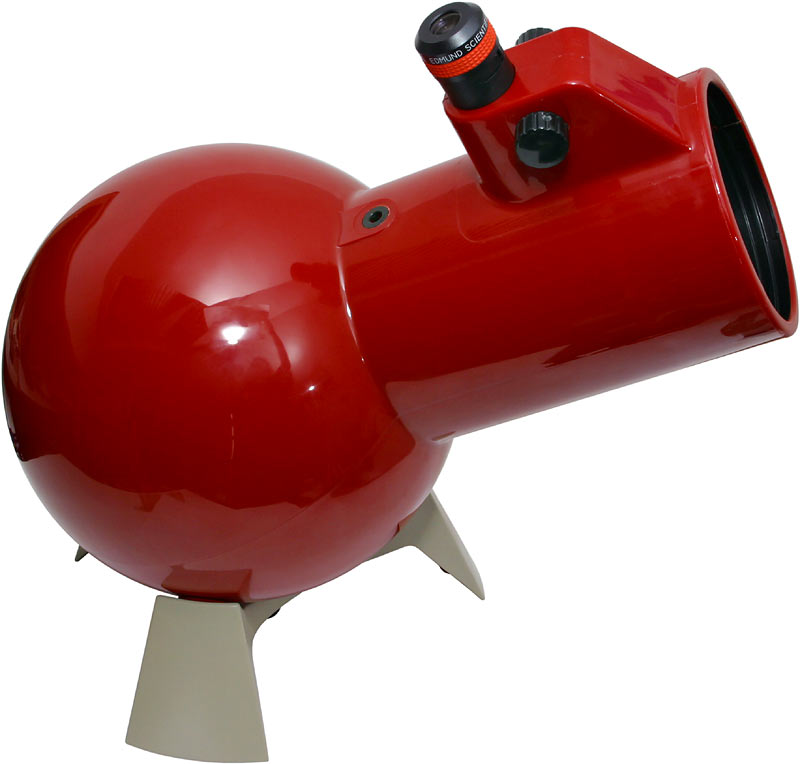
AstroScan (image courtesy Scientifics Online)
Orion StarBlast:
The other decent scope in that price range is the Orion StarBlast. It’s basically an AstroScan in a different shape. The mount is very easy to manipulate – just grab and point. It has a more complex finder-scope on the side than the AstroScan, which means it’s easier to mess up, but it is also slightly easier to use than the AstroScan’s sight.
I also have to admit that Orion got me with this one. They donated a StarBlast to PSC. I was quite skeptical at first, since I love the AstroScan, and I didn’t believe that anything could measure up. After I used it a few times I was sold. It’s a good scope. If I were buying a new scope, I’d buy an AstroScan, but this would be a close second.
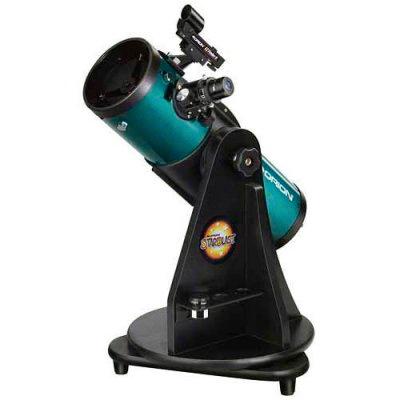
Orion StarBlast (image courtesy Orion)
Both of these scopes are compatible with all the normal-sized eyepieces available on the market. Most telescopes you get from a department store use a different sized opening, so you need to use their eyepieces, and you can’t slowly upgrade over time.
Binoculars:
Good binoculars and a tripod are usually the best option for beginning stargazers, but the scopes we mentioned are pretty close to just as good. We use the Meade Travelview 7x50s (about $30) here at Pacific Science Center, though anything that seems decent will work – even little birding binocs. If you want to be a little bit careful about your binoculars, get a pair of 7x50s from a company that you’ve heard of.
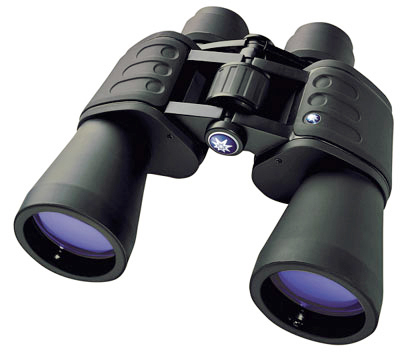
Meade Travelview 7x50s (image courtesy Meade)
What’s Good for Beginners To Look At:
Remember, the Moon is by far the best thing to look at in the sky. The Moon looks huge and fantastic with a wide-field telescope like the Astroscan — you can see the whole Moon and lots of craters. The Moon also looks pretty good through good binoculars. The Moon changes every day — you see different craters each day. You don’t need dark skies to see the Moon. You can see some other things with a backyard telescope (that you can’t see with binoculars), like the rings of Saturn, and nebulas, but almost everything is very tiny or very faint compared to the Moon.
If you want higher magnification, so you can clearly see the stripes on Jupiter, the icecaps on Mars, and the gap in the rings of Saturn, then you will have the problem of how to accurately point a telescope with high magnification, and how to continually move the telescope to counteract the turning of the earth. The best solution is to use a computer and a motor to point the telescope, but this gets expensive. But the cheaper manual fiddly knobs are a pain. Also, if you don’t use a computer to aim your telescope, you need to be sure you have a good finder scope mounted on the side.
This is why I recommend a wide-field telescope like the AstroScan (or good binoculars) for beginners.
Want More?
Sky and Telescope’s advice:
Basics of Telescope Buying
Buying a Telescope as a Gift
More detailed advice:
Keith & Alice Enevoldsen
A List of Dwarf Planets
Updated September 18, 2008
Haumea:
Diameter: 1,320-1,550 km
Orbit Radius: 35.161-51.525 AU
Moons: Hi’iaka and Namaka
Composition: almost all rock
Discovered: 2003 Mike Brown, Chad Trujillo, and David Rabinowitz or Francisco José Aceituno Castro, Pablo Santos-Sanz, and Jose-Luis Ortiz
Resource: http://www.planetary.org/blog/article/00001649/, http://web.gps.caltech.edu/~mbrown/2003EL61/
Other Classifications: Plutoids, Trans-Neptunian Object, Kuiper Belt Object
Make-make:
Diameter: 1,600 km
Orbit Radius: 38.666-52.809 AU
Moons: ?
Composition: ?
Discovered: 2005 Mike Brown, Chad Trujillo, and David Rabinowitz
Resource: http://www.planetary.org/blog/article/00001553,
http://www.mikebrownsplanets.com/2008/06/whats-in-name.html
Other Classifications: Plutoids, Trans-Neptunian Object, Kuiper Belt Object
Eris:
Diameter: 2400 km
Orbit Radius: 38.17- 97.61 AU
Moon: Dysnomia
Composition: roughly half rock, half ice
Discovered: 2003-2005 Mike Brown, Chad Trujillo, and David Rabinowitz
Resource: http://www.planetary.org/explore/topics/trans_neptunian_objects/eris.html
http://web.gps.caltech.edu/~mbrown/planetlila/
Other Classifications: Plutoids, Trans-Neptunian Object, Kuiper Belt Object
Ceres:
Diameter: 950 km
Orbit Radius: 2.98 AU
Moons: none
Composition: rock with 17-27% water ice
Discovered: 1801 by Guiseppe Piazzi
Resource: http://www.planetary.org/explore/topics/asteroids_and_comets/ceres.html
Other Classifications: Asteroid
Pluto:
Diameter: 2,306 km
Orbit Radius: 30.164- 48.494 AU
Moons: Charon, Nix, Hydra
Composition: probably a mixture of 70% rock and 30% water ice
Discovered: 1930 by Clyde Tombaugh
Resource: http://www.nineplanets.org/pluto.html
Other Classifications: Plutoids, Trans-Neptunian Object, Kuiper Belt Object
Want More?
Planetary Names List of Dwarf Planets
Planetary Society List of Notable Trans-Neptunian Objects
Where’d I Get My Info?
Thanks to Mike Brown, Emily Lakdawalla, and Bill Arnett